
What Your Dispatcher Knows That Your System Does Not
The correction that makes a broken plan work has never been written down. Here is what that costs the moment an AI starts answering from the plan.
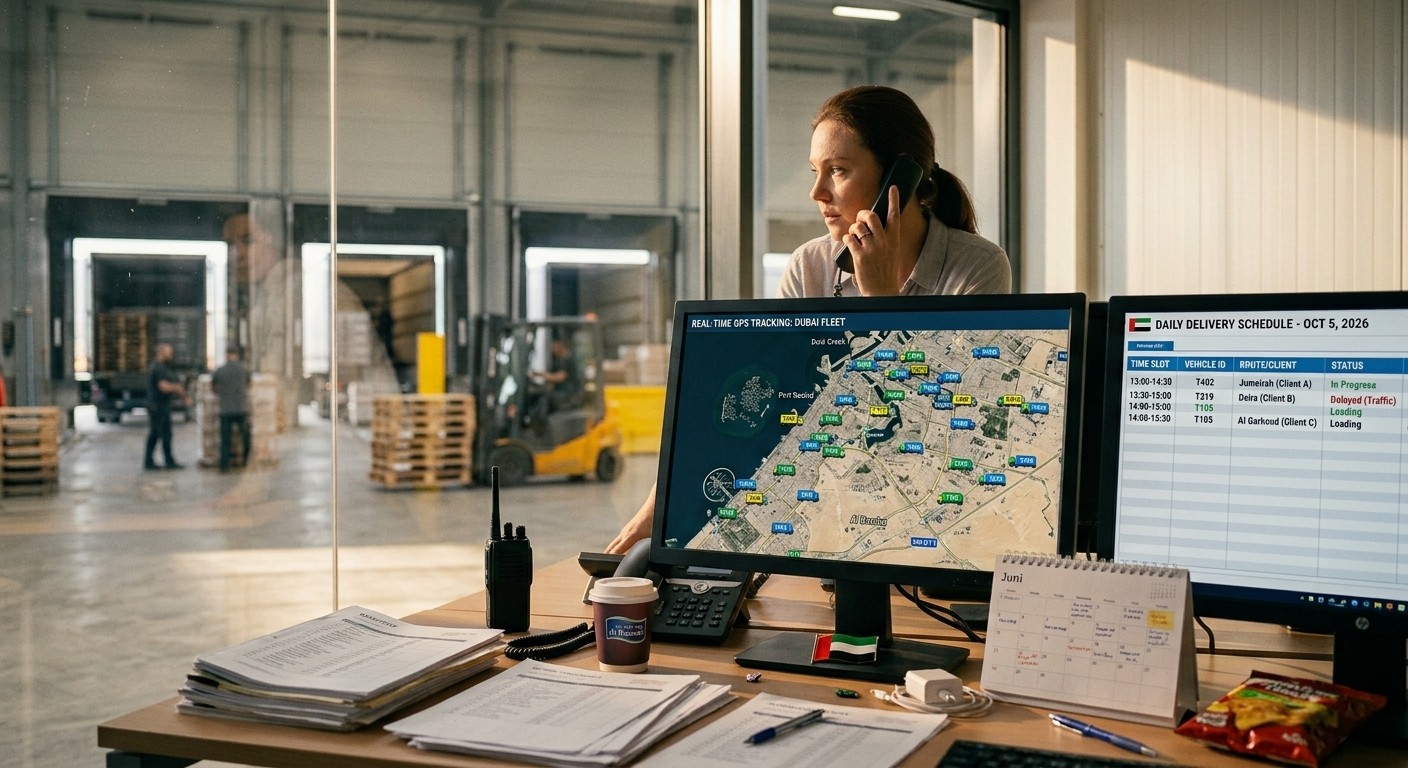
Half past eleven on a Tuesday. The dispatch screen says fourteen vehicles are out and everything is running to plan.
The woman looking at it knows that three of those drops are not happening today.
Nobody has told her. Nothing on the screen is flagged. She has not made a phone call in twenty minutes. She simply knows, and she is already moving two of them to tomorrow before anybody has thought to ask her.
What is she actually doing?
She is applying a correction.
The plan says one thing. Experience says the plan is optimistic by roughly this much, in roughly these places, for roughly these reasons. She subtracts the difference without consciously doing any arithmetic, dozens of times a day, and she is right often enough that the business delivers.
That correction is the most valuable thing in the operation, and it is in no field, no table and no report anywhere in the business.
Why has nobody written it down?
Because it is not a rule, and people have genuinely tried.
It is a thousand small specifics. This customer says two o'clock and means four. That driver's "twenty minutes away" has been forty minutes for six years. This route is fine in traffic and falls apart in rain. That account signs for anything, while this one counts every box and adds eleven minutes to the stop. The third drop on a Monday never goes first time.
None of that is policy. All of it is true.
Write it up as rules and you get a document nobody reads, out of date inside a month, which still misses the half of it she could not tell you she knows.
What is it worth, and what happens when it leaves?
Here is a test you can run this week. Look at how often your plan turns out to be wrong. Then look at how often your customers actually get their delivery.
The gap between those two numbers is the correction. Somebody is closing it every single day, and nobody has ever paid them for it.
Which is fine, right up until the fortnight they go to Spain.
Then the plan gets followed as written, because that is all anybody else has. Promises are made on routes that were never going to run. The damage does not arrive as one visible failure. It arrives as a fortnight that was somehow much harder than usual, and it is almost never attributed to the person who was not there.
Eleven years of operational knowledge, no backup, no handover document, and a week's notice.
Why does this get worse the moment you add AI?
Because an AI reads the plan. It cannot read the correction.
Ask an AI assistant whether an order can go out this afternoon and it does exactly what it was built to do. It finds the route, finds the vehicle, finds the driver, and reports what the system says.
It does not know that this customer's window is nominal. It does not know that the driver on that route is already running fifty minutes behind on a line the screen still shows as green. It does not know about the third drop on a Monday.
So it does not hand you a slightly worse answer than your dispatcher would have given. It hands you the undiscounted one. The plan, read back fluently, with the correction missing.
Which is the reverse of what most people expect when they buy one. Your dispatcher's skill was never knowing what the system says. Anybody can read a screen. Her skill is knowing what the system is wrong about.
We set out the measured version of this in your AI is not guessing, it is reading bad data very confidently. This is the part no amount of data cleaning reaches, because the missing information was never in the data to begin with. It was in somebody's head, and nobody ever asked her for it.
So what would a system have to do differently?
Not replace her. That is the wrong ambition and it has never once worked.
Write down what she already knows.
Not as rules, because rules are what failed. As record. Every time the plan said half past nine and the thing actually happened at ten past ten, that is one of her corrections made explicit, in a field, where somebody who is not her can read it.
Do that for long enough and the difference between the plan and the day stops being folklore and starts being a number. It is still her judgement. It is simply no longer only hers.
How this runs on one platform
Cargo TMS records shifts scheduled against actual rather than scheduled alone, so the gap between what was planned and what happened is kept instead of thrown away at the end of the day. That gap is the correction, written down for the first time.
The dispatch board then carries exceptions as a state in their own right, counted alongside ready, dispatched and en route, rather than as a note somebody meant to make later. Anything slipping is pushed to the top without a person going to look for it, which matters most on the mornings when looking is the first thing to stop happening.
Neither of those makes a dispatcher redundant. They make her legible. The business gets to keep what she knows after she has gone home for the evening, which is a strange thing to have to build on purpose, and stranger still that so few operations have it.
The people running your dispatch desk are not a stopgap until the software gets good enough. They are doing something the software has never once been asked to do.
Frequently asked questions
What is tribal knowledge in a logistics operation?
It is the operational understanding that lives in experienced people rather than in any system: which customers treat a delivery window as approximate, which routes behave differently in bad weather, how long a particular site actually takes to unload. It is usually accurate, usually unwritten, and usually invisible until the person holding it is unavailable.
Why do dispatch plans need correcting during the day?
Because a plan is built before the day starts and the day does not cooperate. The correction is not a sign of a bad plan. It is the normal work of running an operation, and in most businesses it is performed informally by one or two people whose adjustments are never recorded anywhere.
What is key person risk in an operations team?
It is the exposure a business carries when critical operating knowledge sits with an individual and nowhere else. In transport it shows up when an experienced planner takes leave and service quality drops for reasons nobody can point to afterwards, because the thing that was missing was never documented in the first place.
Why does an AI assistant struggle with questions a dispatcher answers easily?
Because the dispatcher is answering from the plan plus an unrecorded correction, and the AI only has the plan. The correction was never captured in any system, so no model can retrieve it. The result is a confident answer built on an intention rather than on what is actually going to happen.
More in this series
This piece is one argument out of a larger one. The overview, with the research, is your AI is not guessing, it is reading bad data very confidently.
And the foundation underneath both: what operations actually means, on why the work runs down through a business while the ERP looks across it.
Talk to us about what your dispatch board should be telling you
For media inquiries, please contact:
contact@illuminate.ae