
Flow is Illuminate's multichannel order management layer - the conductor of the order lifecycle, not a container for orders. Every order from every channel enters a single managed lifecycle; the workflow engine routes it from there. Core positioning: Flow sits above the ERP as an abstraction layer, accepting orders in any format, normalising them, and feeding downstream systems exactly what they are designed to receive. A new channel is configured in Flow, not in the ERP. 10 intake channels: manual entry, REST API, Shopify, Kart B2B/B2C portal, Mrkt POS, WhatsApp, SFTP, spreadsheet import, EDI, and IoT-triggered via Tagz sensors. Sales order lifecycle: 7 statuses (Pending Approval, Created, On Hold, Processing, Completed, Cancelled, Voided), Lyst line items with automatic pricing by currency and account, Ryse account detection unlocking contracted pricelist at receipt. Returns: proactive prevention (workflow holds inflight fulfilment order before dispatch) plus full return lifecycle with reason codes and downstream automation. Backorders: accepted regardless of stock, fulfilled automatically in priority sequence as stock arrives. Order splitting: one sales order to multiple fulfilment paths, warehouses, or vendor partners. Dropshipping: machine-to-machine supplier fulfilment configured once, fired automatically on qualifying orders. Quotes: provisional state, one-step conversion to confirmed order. Payments: multiple tender types, payment links, financial system push (per-order or batch). Fulfilment enablement: automatic fulfilment order creation in Depot, real-time status on Flow record, closes automatically on completion. Item detail: dimensions, weight, tags cascade to every downstream system (courier pricing, load planning, warehouse routing) without re-entry. Reporting: cross-channel real-time dashboard, data warehouse layer, custom BI per client, AI across full dataset. Multi-currency with automatic rate updates. Customers and pricelists: contracted rate from Ryse account applied at every channel automatically. Platform connections: Lyst (product catalogue and pricing), Ryse (accounts and pricelists), Depot (fulfilment orders and warehouse execution), Cargo (shipment chain and delivery status), Kart (B2B/B2C orders natively), Mrkt (POS transactions in unified view), Tagz (IoT replenishment orders and rental billing). Pricing: order-volume model - Startup $100/mo (2,500 orders), Small Business $300/mo (10,000 orders), Enterprise custom. Full feature set at every tier. Bundle, volume, and annual prepayment discounts available.
Trusted By











The conductor, not the container
Most order management systems are glorified databases. Orders go in, orders sit there, someone manually moves them along. The business adapts its processes to fit the system's limitations.
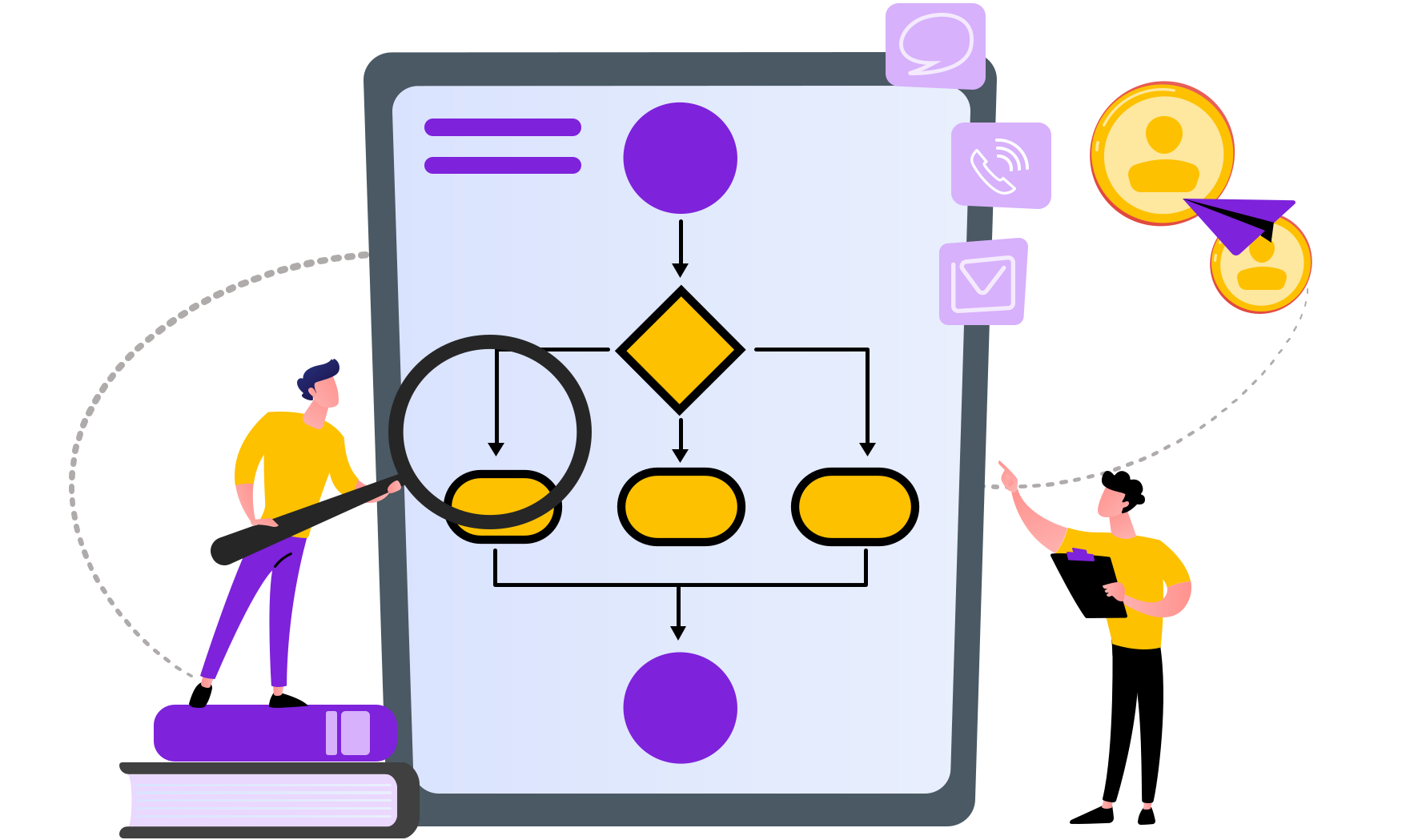
Flow is built on a different model. Every order event fires a named workflow. The business defines the logic - hold this for approval, route that to a specific warehouse, push this channel's orders to the ERP, notify the customer at each status change. Flow executes it. The routing decisions happen in the platform, not in someone's inbox.
The ERP never needs to be exposed to the channel. A new sales channel is configured in Flow, not in the ERP. Add WhatsApp ordering, a new marketplace, or a B2B portal without a system integration project. Every channel normalised, every order managed from one place.
Book a Demo
Built for your business
Every commercial model. Every channel.
Flow is not category-specific. The same conductor model works for a retailer adding e-commerce to an existing ERP, a distributor managing B2B accounts across multiple warehouses, and a manufacturer routing orders to fulfilment partners.
E-commerce & DTC
Shopify and API orders in a managed lifecycle. Fulfilment automated to the warehouse. Customer account built from every transaction.
B2B & Wholesale
Contracted pricing applied at receipt. Approval workflows for high-value orders. EDI and SFTP for key account bulk ordering.
Multi-location Retail
POS and digital orders in one view. No separate exports or end-of-day reconciliation between systems.
Distribution
Orders split to multiple warehouses automatically. Backorders fulfilled in priority sequence. ERP receives clean, normalised payloads.
Manufacturing
Orders trigger component consumption in Depot. Fulfilment routes to the correct production or assembly point based on product type and tags.
Marketplace Sellers
Multi-vendor marketplace orders split automatically. Each vendor's fulfilment tracked independently against the parent order.
10 intake channels
Every way an order can arrive
A single order lifecycle for every source. The channel tag travels with every order and is available as a condition in every workflow rule throughout the lifecycle.
Manual Entry
Any authorised team member creates an order directly in Flow. Product and customer data pulled from Lyst and Ryse automatically.
REST API
Any external system pushes orders into Flow via API. Channel identified by short code, workflow routes accordingly.
E-commerce
Orders from Shopify, WooCommerce, Magento, and other platforms sync into Flow automatically. Products map to Lyst, customers map to Ryse, workflow rules apply on receipt.
Kart B2B / B2C
Orders placed through the Kart portal arrive with the correct channel tag, account link, and contracted price list already applied.
Mrkt (POS)
Point-of-sale transactions from Mrkt terminals enter Flow under the retail channel for a single view across in-store and digital.
Orders received via WhatsApp through the Illuminate integration layer are normalised and entered as fully managed orders.
SFTP File Transfer
File-based intake for distributors, key accounts, or legacy systems. Parsed, validated, and entered as standard orders.
Spreadsheet Import
Bulk order entry via structured upload for periodic batch orders, key account processing, or data migration.
EDI
Electronic Data Interchange for large retailer and distributor B2B exchange. Received, normalised, and entered without touching the source system.
IoT-Triggered
Tagz sensors detect a threshold breach and Flow creates a replenishment order automatically. No OMS anywhere else offers this.
Third-party integrations
Connected to the systems you already run.
Flow sits above your ERP as an abstraction layer - not a replacement for it. New channels connect to Flow, not to the ERP. A sample of supported integrations - see the full list.
Sales orders
The full order lifecycle, under your control
Every order in Flow has a status that determines where it is in the lifecycle and exactly what the workflow engine should do next. Seven statuses, unlimited routing logic, zero manual handoffs.
7-status lifecycle
Pending Approval - Created - On Hold - Processing - Completed - Cancelled - Voided. Configurable workflow actions at every transition.
Automatic pricing
Line items drawn from Lyst. Pricing resolved from the correct rate card and currency at the moment the order is created. No manual lookup.
Quotes to orders
Quotes use the same structure as sales orders but in a provisional state. When the customer accepts, one step converts to a confirmed order with no re-entry.
Backorders
Accept orders regardless of stock. Backordered items fulfil automatically through Depot as incoming stock is received. No manual check-and-dispatch.
Returns & prevention
Returns linked to originating orders by line item. Workflow can intercept inflight fulfilment before it leaves the warehouse. The best return is the one that never happens.
Payments
Payment status visible on every order. Multiple tender types per order. Financial system push per-order in real time or consolidated batch.


Channel management
All channels in one view. No spreadsheet exports.
Every order is tagged to a named sales channel at the point of creation. The channel tag travels through the entire lifecycle and is available as a condition in every workflow rule.
Channel types
Retail, E-Commerce, B2B, Marketplace, Integration. Each channel has a short code, a linked Lyst catalogue, and its own intake configuration.
Cross-channel dashboard
Revenue by channel, orders pending, in processing, and completed - all in real time. "What are my sales today" answered in seconds, not hours.
ERP protection
All channels connect to Flow. The ERP receives clean normalised payloads. A new channel is a Flow configuration, not an ERP integration project.
Multi-currency
Every order denominated in the currency of its channel or account. Rates updated automatically. No separate price list management per currency.
Contracted pricelists
Ryse account matched at receipt by any property. Contracted pricelist applied automatically. Every channel, every order, correct pricing without manual intervention.
Workflow routing by channel
The channel tag is a condition in every workflow rule. Different approval workflows, fulfilment paths, or ERP routes for different channels - configured once, executed on every order.
Fulfilment & routing
Complex orders routed intelligently. No manual handoffs.
Flow initiates and orchestrates the fulfilment process. When a sales order is confirmed and workflow conditions are met, a fulfilment order is created in Depot automatically. From there, every leg of every order is tracked back to the parent record.
Automatic FO creation
Confirmed sales order fires a fulfilment order in Depot with line items, delivery address, priority, and channel context. No manual data transfer.
Order splitting
One sales order to multiple fulfilment orders across warehouses, fulfilment paths, or vendor partners. Marketplace orders from multiple vendors split automatically.
Dropshipping
Workflow rule fires an outbound API call to the supplier automatically. Machine-to-machine, configured once. Mixed orders split: warehouse lines to Depot, drop-ship lines to supplier simultaneously.
Real-time status
Fulfilment status from Depot visible on the Flow order record in real time. Customer-facing teams see live status without accessing the warehouse system.
Item dimensions & tags
Dimensions, weight, and product tags from Lyst cascade to Cargo for load planning and courier pricing. Entered once in Lyst, used everywhere below.
Delivery chain
When a fulfilment order reaches dispatch stage, a shipment is created in Cargo automatically. Delivery status is visible on the Flow order without accessing Cargo.


Reporting & intelligence
Every order event becomes business intelligence
Flow's unified order record across every channel and every order type is the foundation for cross-channel business intelligence. No separate platform exports, no combining spreadsheets - one dataset, every insight.
Live order dashboard
Total orders, pending approval, in processing, cancellations, and revenue - configurable by date range. Searchable and filterable across any dimension.
Cross-channel metrics
Revenue by channel, average order value by customer tier, return rate by product category - all from one system. No separate exports to combine.
Customer intelligence
Lifetime Value, YTD Revenue, and Average Order Value computed from Flow data and surfaced live on every Ryse account record.
Data warehouse layer
Every platform event feeds the central data warehouse: orders, fulfilment, payments, returns, logistics. Custom reports built once, available in real time from that point forward.
AI across the dataset
Customer behaviour and churn prediction, demand forecasting by SKU and channel, purchase management and supplier optimisation - applied across the full operational picture.
Custom BI per client
Not the reports the vendor decided to include. The reports the business actually needs - configured once against the client's own data model and available on demand.
Beyond standard order management
Built for businesses that don't fit the template
Most OMS tools assume quantity multiplied by a unit price. That breaks for any business where the charge follows distance, time, usage, or a contracted rate structure. Flow handles all of it from the same platform.
Omni-channel, multi-region retail
A business trading across the UAE, UK, and US - with e-commerce, physical stores, and B2B accounts in each market - runs from one platform. Region-specific pricing, localised warehouses, and channel-appropriate currency applied automatically. One order view, one reporting layer, across every market and every format.
- Per-region pricing and currency - configured once
- Warehouse routing by region, channel, or product type
- E-commerce, POS, and B2B orders in one unified view
Courier & delivery
Zone + weight billing resolved at the moment a shipment is created. Multi-variable rate cards combine base rate, weight band, and surcharges. The charge locks to the record at dispatch - no month-end reconstruction.
- Zone + weight billing at dispatch
- Base rate + surcharges in one rate card
- Per-client tariff structures from account record
Rental & equipment hire
Cranes billed per lift. Hire cars by day and kilometre. Generators by kilowatt-hour consumed. Usage data from Tagz sensors feeds the rate card automatically - the invoice is built from what the asset actually did.
- Per day / week / month - time-based rental
- Per km / per hour / per lift - usage-based
- Verified Tagz data, no manual reconstruction
Data centres & provisioned assets
VMs, servers, and bandwidth provisioned as billable products. Each asset billed by cores, RAM, or GB consumed. Usage tracked through Tagz and fed into Lyst rate cards - consumption billing without a separate platform.
- Provisioned assets as billable products
- Consumption billing by resource (cores, GB, bandwidth)
- Tiered usage bands with overage pricing
Schools & education
Student billing by course, term, or module. Classroom and resource allocation tracked as orders. Per-student, per-session, and bundled term pricing - all managed in Flow with account-level invoicing to parents or institutions.
- Per-student and per-session billing
- Term and module bundled pricing
- Account invoicing to parents or institutions
Automotive
Tiered dealer and distributor price lists applied by account tier and region. Zone-based delivery billing from the distribution chain. Parts, service, and vehicle orders managed in one system with channel-appropriate pricing at every point.
- Dealer / distributor price lists by tier
- Zone-based delivery billing across distribution chain
- Parts, service, and unit orders in one view
No separate billing module. No parallel spreadsheet process. The pricing mechanism lives on the product. The usage data comes from the platform. The charge resolves automatically when the order event occurs.
Platform advantage
What each connection makes possible
Flow is where orders are created, enriched, and directed. These are the business outcomes when the platform reads from and writes back to every connected product.


Every order line priced correctly at creation - no rate lookup
Every line item in Flow references a Lyst product. At the moment of order creation, Flow resolves the correct pricing mechanism - Simple, Slabs, Time-based, or Custom rate card - in the correct currency. Per-client contracted rates applied automatically from the account record. The order is priced before the team member finishes creating it.
Learn about Lyst →

Customer detected at receipt - contracted pricing applied automatically
Ryse account matched at the moment the order arrives - by email, customer code, phone, ERP reference, or any account property. The contracted pricelist for that account unlocks immediately. Without this, every channel manages pricing independently and the problem permeates outwards through every order that channel processes.
Learn about Ryse →

Fulfilment initiated automatically - the warehouse never waits for a handoff
When a sales order is confirmed in Flow, a fulfilment order is created in Depot automatically. Line items, delivery address, priority, and channel context transferred without re-entry. Fulfilment status updates in real time on the Flow order. When the FO closes in Depot, the sales order closes in Flow. No manual reconciliation.
Learn about Depot →

Delivery chain initiated from the order - live status without touching Cargo
When a fulfilment order reaches dispatch stage, a shipment is created in Cargo. Delivery address, product dimensions, weight, and handling requirements travel without re-entry. Cargo delivery status is visible on the Flow order record, giving customer-facing teams a live picture without direct Cargo access. Driver's line-by-line item verification at the door updates the Flow order in real time.
Learn about Cargo →

B2B and B2C orders are Flow orders natively - no sync layer
Kart orders are not synced to Flow - they are Flow orders. No mapping, no gap, no delay. Centralised Lyst pricing applied at checkout. B2B account detected, contracted pricelist applied before the buyer completes the purchase. Approval workflows, payment gating, and downstream automation apply on every Kart order as if it were created directly in Flow.
Learn about Kart →

Sensors trigger replenishment orders - no human in the loop
Through the Tagz IoT integration layer, a physical sensor detecting a threshold breach creates a replenishment order in Flow automatically. No traditional OMS offers this. Additionally, asset deployment periods from Tagz - GPS mileage, IoT operating hours, scan events - connect directly to Flow billing records for rental invoicing without manual reconciliation.
Learn about Tagz →

In-store sales in the same dashboard as every other channel
Every Mrkt POS transaction enters Flow under the retail channel. In-store orders join the unified cross-channel dashboard - no separate POS export, no daily reconciliation. Customer account matched at the terminal, in-store purchases appear on the Ryse account timeline. Centralised Lyst pricing at every terminal: a price change propagates immediately without a per-terminal update.
Learn about Mrkt →
How Flow compares
Flow is the only OMS built as a conductor.
The question is not just which system can track the most order statuses. It is which system can route, enrich, and act on every order automatically - without adding channels to the ERP.
| Flow | Dedicated OMS Brightpearl, Linnworks, Cin7 |
E-commerce platform Shopify Plus |
ERP order modules SAP, Oracle, Dynamics |
|
|---|---|---|---|---|
| Order intake | ||||
| 10 intake channels including EDI, SFTP, WhatsApp, and IoT-triggered | ✓ | ◐ | - | ◐ |
| IoT sensor-triggered order creation (no human in the loop) | ✓ | - | - | - |
| ERP protection layer - channels never exposed to the ERP | ✓ | ◐ | - | - |
| Workflow and routing | ||||
| Configurable workflow engine - condition-based routing at every order event | ✓ | ◐ | - | ◐ |
| Order splitting to multiple warehouses, paths, or vendor partners | ✓ | ✓ | - | ◐ |
| Proactive return prevention - hold inflight FO before dispatch | ✓ | - | - | - |
| Dropshipping with machine-to-machine supplier fulfilment | ✓ | ✓ | ◐ | ◐ |
| Pricing and customers | ||||
| Centralised pricing from product catalogue - no per-channel management | ✓ | - | - | ◐ |
| Per-client contracted pricelist applied automatically at receipt | ✓ | ◐ | ◐ | ✓ |
| Customer account matched by any property (email, ERP code, phone, custom) | ✓ | ◐ | - | ◐ |
| Distance-based pricing - per km, zone + weight rate cards for courier billing | ✓ | - | - | - |
| Time-based pricing - per day / week / month for rental and deployed assets | ✓ | - | - | - |
| Usage-based billing - per km, per operating hour, per lift from verified data | ✓ | - | - | - |
| Multi-variable rate cards - zone + weight + surcharges resolved at dispatch | ✓ | - | - | - |
| Billing from verified operational data - no month-end manual reconstruction | ✓ | - | - | - |
| Reporting and intelligence | ||||
| Cross-channel real-time dashboard - all channels in one view | ✓ | ✓ | ◐ | ◐ |
| Data warehouse and custom BI layer built on client's own dataset | ✓ | ◐ | - | ◐ |
| Customer LTV, YTD revenue, and AOV surfaced live on CRM record | ✓ | - | - | ◐ |
| Platform connectivity | ||||
| Native WMS - fulfilment orders in Depot, real-time status back on order | ✓ | ◐ | - | ◐ |
| Native TMS - shipment created from order, delivery status back on record | ✓ | ◐ | - | - |
| Native POS - in-store orders in unified cross-channel dashboard | ✓ | ◐ | ◐ | ◐ |
| Order-volume pricing - no per-user, no per-channel, no per-integration cost | ✓ | - | - | - |
| Integrations | ||||
| ERP integration - SAP, Oracle, Dynamics 365, NetSuite, Odoo | ✓ | ◐ | ◐ | ✓ |
| E-commerce - Shopify, WooCommerce, Magento | ✓ | ✓ | ✓ | ◐ |
| EDI - large retailer and distributor B2B order exchange | ✓ | ◐ | - | ✓ |
| WhatsApp order intake - normalised into managed order lifecycle | ✓ | - | - | - |
| Payment gateway integration - Stripe, PayTabs, and custom gateways | ✓ | ◐ | ◐ | ◐ |
| Bidirectional real-time sync - channel to ERP, no manual export | ✓ | ◐ | - | ◐ |
◐ = available via additional configuration, custom development, or third-party integration at extra cost
Pricing
Order-volume pricing - no per-user costs, no per-channel costs, no per-integration costs. The full Flow feature set from day one.Startup
For businesses starting out or running moderate order volumes. Full Flow feature set from day one - all intake channels, workflow automation, and platform connections.
Up to 2,500 orders / month
$100/mo
per month
Start Free
Perfect For:
- Growing e-commerce businesses
- Small distributors and wholesalers
- Businesses adding digital channels
- Teams replacing manual order spreadsheets
What's included:
- All 10 intake channels
- Sales order lifecycle management
- Quotes and backorders
- Order splitting and dropshipping
- Workflow automation engine
- Returns management
- Payment management
- Cross-channel reporting dashboard
- Lyst, Ryse, Depot, Cargo, Kart, Mrkt, Tagz connections
Small Business
For businesses managing higher order volumes across multiple channels. Same complete feature set as Startup, scaled for businesses that have grown past the entry volume.
Up to 10,000 orders / month
$300/mo
per month
Start Free
Perfect For:
- Multi-channel retailers and distributors
- B2B businesses with multiple sales reps
- Businesses running Illuminate platform products
- Operations with multiple warehouses or fulfilment paths
What's included:
- Everything in Startup
- Higher order throughput (10,000/mo)
- Multi-currency with auto rate updates
- Advanced workflow rules
- ERP integration support
- Data warehouse and BI layer access
Enterprise
For businesses above 10,000 orders per month. Multi-entity support, multiple ERP integrations with advanced routing, dedicated onboarding and SLA-backed support commitments.
10,001+ orders / month
Let's talk
custom pricing
Contact Us
Perfect For:
- High-volume B2B and B2C operations
- Multi-entity and multi-ERP businesses
- Complex routing and approval workflows
- Businesses requiring dedicated SLAs and support
What's included:
- Everything in Small Business
- Multi-entity support across business units
- Multiple ERP integrations with advanced routing
- Custom workflow configuration scope
- Dedicated onboarding and configuration
- SLA-backed uptime and support
- AI across full operational dataset
Discounts on every plan
- Bundle discount when you subscribe to more than one Illuminate product
- Annual prepayment discount available on all plans
- Volume scaling built into tier structure - effective per-order cost decreases as volume grows
Frequently asked questions
Everything you need to know about Flow before your first demo.
What is Flow?
Flow is Illuminate's multichannel order management layer. Every order from every sales channel arrives in a single managed lifecycle - and the workflow engine routes it from there. Flow is not a container for orders. It is a conductor: the business defines the routing logic, and Flow executes it at every stage of the order lifecycle.
What channels can Flow receive orders from?
Flow accepts orders from 10 intake sources: manual entry, REST API, Shopify, Kart B2B and B2C portal, Mrkt POS terminals, WhatsApp, SFTP file transfer, spreadsheet import, EDI for large retailer and distributor exchange, and IoT-triggered orders via Tagz sensor integration. Every order arrives in the same managed lifecycle regardless of source.
How does Flow protect the ERP?
Flow sits above the ERP as an abstraction layer. Orders arrive from every channel in their native format, are normalised in Flow, and pushed to the ERP as clean, structured payloads. The ERP never needs to be exposed to the channel. A new channel - WhatsApp, a new marketplace, a B2B portal - is configured in Flow, not in the ERP. No ERP project, no system integration work required.
How does pricing work in Flow?
Every order line in Flow references a Lyst product. At the moment of order creation, Flow resolves the correct pricing mechanism - Simple, Quantity Slabs, Time-based, Distance-based, or Custom rate card - in the correct currency. When the order is linked to a Ryse account, the contracted pricelist for that account is applied automatically. The team member does not select a price - Flow applies the correct one based on who the customer is and what they have agreed.
Can Flow handle orders from multiple warehouses?
Yes. A single sales order can be split into multiple fulfilment orders routed to different warehouses, fulfilment paths, or vendor partners. Marketplace orders from multiple vendors split automatically. Routing logic is configured in the Flow workflow engine - based on product location, stock availability, channel, capacity, or any combination. Each split fulfilment order is tracked independently and rolls up to the parent sales order in Flow.
What makes Flow different from Brightpearl or Linnworks?
Dedicated OMS platforms are strong at managing order status. Flow goes further: it is the conductor of the order lifecycle, not just a tracker of it. The key differences: Flow's workflow engine routes orders by condition rather than by manual action; centralised Lyst pricing eliminates per-channel price management; IoT-triggered order creation through Tagz is unique to the Illuminate platform; and proactive return prevention can hold inflight fulfilment orders before they leave the warehouse. Everything is priced on order volume - not per user, not per channel, not per integration.
How does Flow handle returns?
Returns in Flow include proactive prevention as well as management. The workflow engine can intercept an inflight fulfilment order in Depot before it leaves the warehouse - holding it on a quality flag, a return pattern flag, or a customer hold. When a return does occur, it is linked to the originating order by order ID and line item, with reason codes and a full status lifecycle. Downstream automation fires on return events - inventory receipt, credit notes, account balance adjustment - through the workflow engine.
Does Flow work alongside our existing ERP?
Yes - Flow is designed to sit above the ERP, not replace it. The ERP remains the financial system of record. Flow becomes the order intake and routing layer that the ERP never had to be. Orders are pushed to the ERP as clean, normalised payloads through the workflow engine. Many businesses use Flow to add digital channels - e-commerce, WhatsApp, marketplace - without modifying the ERP or rebuilding existing integrations.
How is Flow priced?
Flow is priced on order volume - not per user, not per channel, not per integration. Startup is $100/month for up to 2,500 orders. Small Business is $300/month for up to 10,000 orders. Enterprise pricing is custom above 10,000 orders per month and includes multi-entity support, multiple ERP integrations, and dedicated SLAs. Every tier includes the full feature set from day one. A team of two and a team of twenty processing the same order volume pay the same.
Platform connections
Book a Demo
See the Platform
The order layer every Illuminate product feeds into
Flow is where the commercial intent of the business is captured and converted into operational instructions. Every connected product either feeds into Flow or depends on data that starts here.
We'd love to hear from you!
Whether you have a question, feedback, or just want to say hi, please don't hesitate to contact us through the form below. We'll get back to you as soon as possible.
Phone: (+971) 58 524 3821
Whatsapp: (+971) 58 524 3821
Whatsapp: (+971) 58 524 3821
Headquarters:
Dubai, United Arab Emirates
Locations:
Bangalore, India
Vancouver, Canada
Dubai, United Arab Emirates
Locations:
Bangalore, India
Vancouver, Canada