
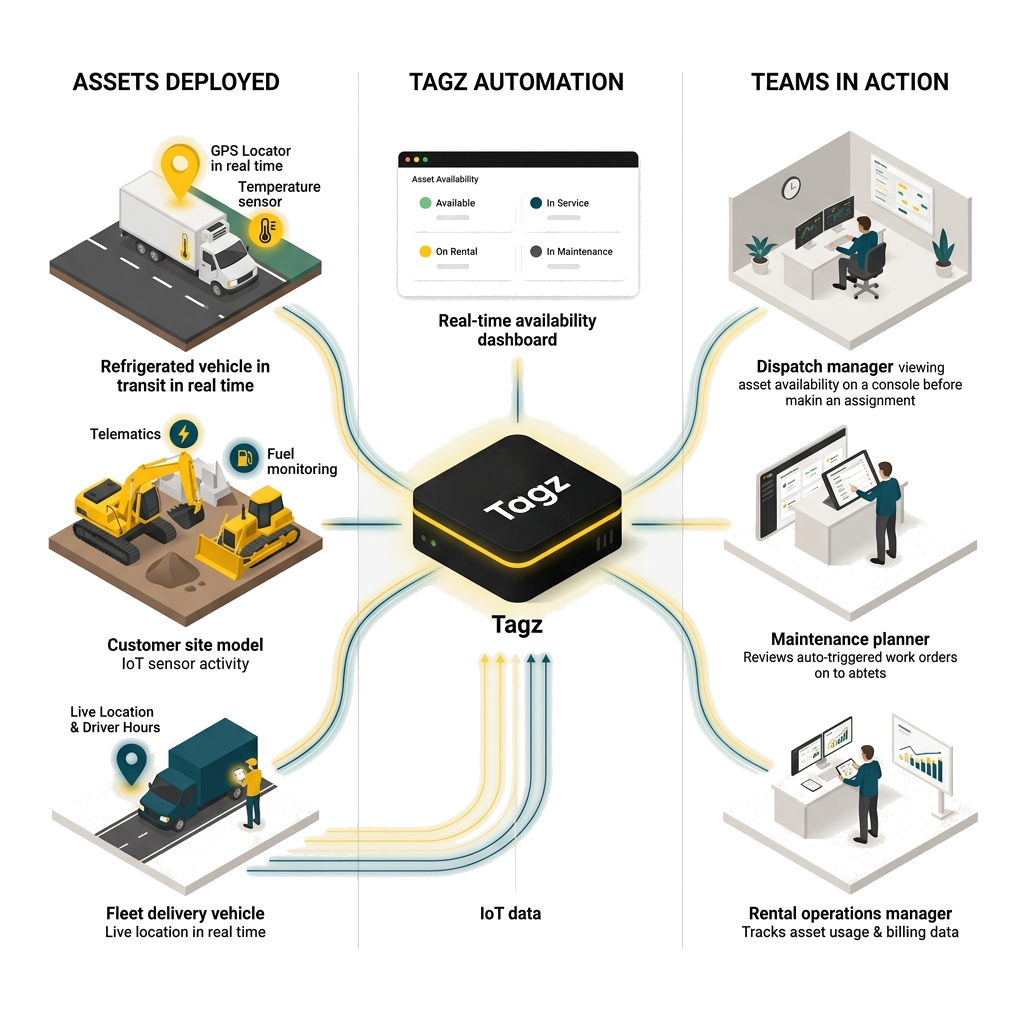
Tagz is Illuminate's Asset Intelligence Platform. It connects every physical asset to the operational life of the business: the customer account it is deployed against, the IoT sensors reporting its condition in real time, the service order tracking its movement through a workshop, and the workflow engine that fires automatically when a threshold is crossed. Core capabilities: configurable asset registry with unique Tag IDs, custom property schemas per asset type (configured in settings, no code), asset classes with independent colour-coded status sets, three-level custody (customer account in Ryse, internal user, external person with name/ID/location), service orders for closed-loop collect-process-return with scan-based custody transfer and conflict detection, label templates with barcode and QR code generation for browser-based PDF printing, work orders with three trigger types (time-based schedule, IoT-event mileage/hours threshold, date-property expiry for licences and certifications), IoT integration across 12 device categories (GPS telematics, temperature sensors, tank/level sensors, RFID, BLE beacons, weight/scale machines, dash cams, ELD devices, network/control systems), automated workflow engine responding to any IoT event or asset status change, real-time asset availability reflecting service orders and maintenance, rental and lease billing where Tagz usage records feed Lyst rate cards and Flow invoicing, asset performance reporting (revenue per asset, utilisation rates, maintenance cost, idle time), customer-facing portal for clients to see live asset status without operational system access. Platform integrations: Cargo (verified vehicle constraints, live fleet availability, GPS mileage triggering maintenance work orders), Ryse (assets linked to customer accounts, custody events on account timeline), Flow (rental invoicing from asset usage records), Depot (load planning with verified vehicle specs), Lyst (rate cards applied to rental periods), Kart (booking-to-asset deployment workflow).
Trusted By











Asset existence vs asset availability
Knowing what you own is only the starting point. The more important operational question is whether an asset is available — and available for what.
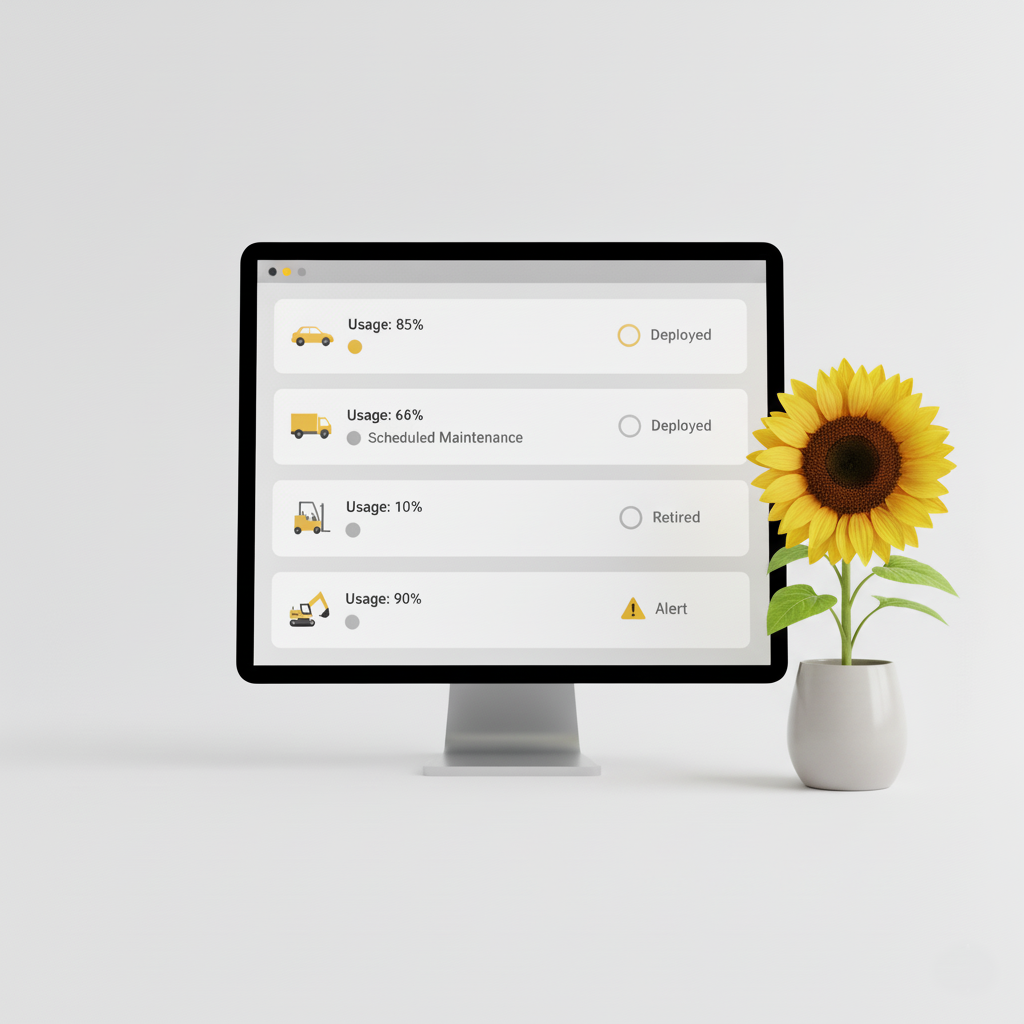
An asset can exist in the registry but be unavailable for any number of reasons: it's out on rental at a customer site, it's in for service, it's waiting on a part, it's scheduled for maintenance next week, or it's reserved for an upcoming order. Tagz tracks this state in real time. Dispatchers, planners, and rental teams know not just what assets they have, but which are free to assign right now and which are committed.
A rental company asked whether a crane is free for a given date can check without calling the depot. A fleet manager scheduling preventive maintenance can see which vehicles can be taken offline without impacting dispatch commitments. A business receiving an order requiring refrigerated storage can immediately see which units are available.
Book a Demo
What Tagz manages
One intelligence layer. Every asset type.
From a laptop to a crane to a data centre rack to an oil tank in the field — all managed on the same framework.
The asset type changes. The intelligence layer does not.
IT & Hardware Assets
Laptops, phones, servers, switches, and racks tracked with full hardware specs, serial numbers, assigned user, and service history. The complete IT estate without a separate ITAM tool.
Fleet & Vehicles
Every vehicle with payload capacity, volume, ownership type, assigned driver, and live availability. Vehicle constraints verified before dispatch. Routes are never planned against a truck that is in a workshop.
Rental & Leased Equipment
Cranes, photocopiers, heavy machinery, and PPE linked to the customer account at deployment. Full usage record on return: time out, IoT readings, service history. Ready for billing.
Field Infrastructure
Oil tanks, fuel stores, liquid nitrogen containers, and water reservoirs in the field. Level sensors report continuously. When a reading hits a configured threshold, a purchase order fires automatically.
Co-Location & Data Centre
Client racks, cages, and units tagged and monitored. Real-time feeds from temperature sensors, power monitoring, and network control systems. Clients see their own assets through the portal.
Property & Building Assets
Apartments, commercial units, building systems, and maintenance equipment classified and monitored. Maintenance history on the asset record. Work orders track every intervention.
Asset registry & configuration
See Asset Registry
Every asset. Every attribute. Exactly right.
A vehicle has a payload weight and a service interval. A laptop has a serial number and a warranty date. A refrigerated trailer has a temperature range and a calibration certificate. Generic asset tools force all of these into the same flat record. Tagz does not.
Custom property schemas per type
Define exactly what fields appear on every asset of a type: text, number, or dropdown. Required or optional. Configured in settings, no code required.
Asset classes with own status sets
Each class carries its own colour-coded status vocabulary. A vehicle class uses Available / In Maintenance. A rental class uses On Rental / Awaiting Service. Completely independent.
Three-level custody
Link to a customer account in Ryse, assign internally to a user, or record an external person (name, ID, location) for assets at customer sites. Full custody chain always visible.
Complete event history
Every movement, service order, status change, IoT event, and note logged in reverse-chronological order on the asset record. The full audit trail in one place.
Service orders
See Service Orders
From collection to return. Every step on the record.
When an asset leaves a customer site, goes through a workshop, and comes back — every step needs to be tracked, verified, and reconciled. Service orders manage that entire cycle without manual effort.
Three-party closed loop
Collect from a verified account address, process through a warehouse or workshop, return to a destination. Each stage tracked and confirmed.
Scan-based transfers
Warehouse staff scan assets in and out at each custody point. Reconciliation is automatic. No manual tally, no discrepancy risk.
Conflict detection
An asset cannot be transferred to the wrong account. Conflict detection catches cross-account errors before the scan is accepted.
Printable & searchable
Service orders generate as printable documents for warehouse teams. Searchable by order ID and external reference fields for cross-system linking.
Work orders & maintenance
See Work Orders
Automated maintenance scheduling. Set the conditions once.
Work orders can be created manually. In Tagz, the more powerful model is automated: the platform creates the work order when the condition is met, without anyone needing to monitor it.
Scheduled: time-based
Set a maintenance interval and the work order appears on schedule. Monthly inspections, annual certifications, weekly safety checks — all configured once.
IoT-triggered: usage threshold
GPS mileage or operating hours from Cargo telematics accumulate against the asset. At 60,000 km, an oil change work order fires. At 100,000 km, a full service. No one monitors the odometer.
Date-property triggered
A date field on the asset (licence expiry, warranty end, certification renewal) triggers a work order before the date passes. Nothing lapses unnoticed.
Assignment & scheduling
Work orders are assigned to technicians and scheduled. The asset's availability status updates automatically. It cannot be assigned to a job while it is under maintenance.
IoT Integration
Not just monitoring. The trigger layer for automated operations.
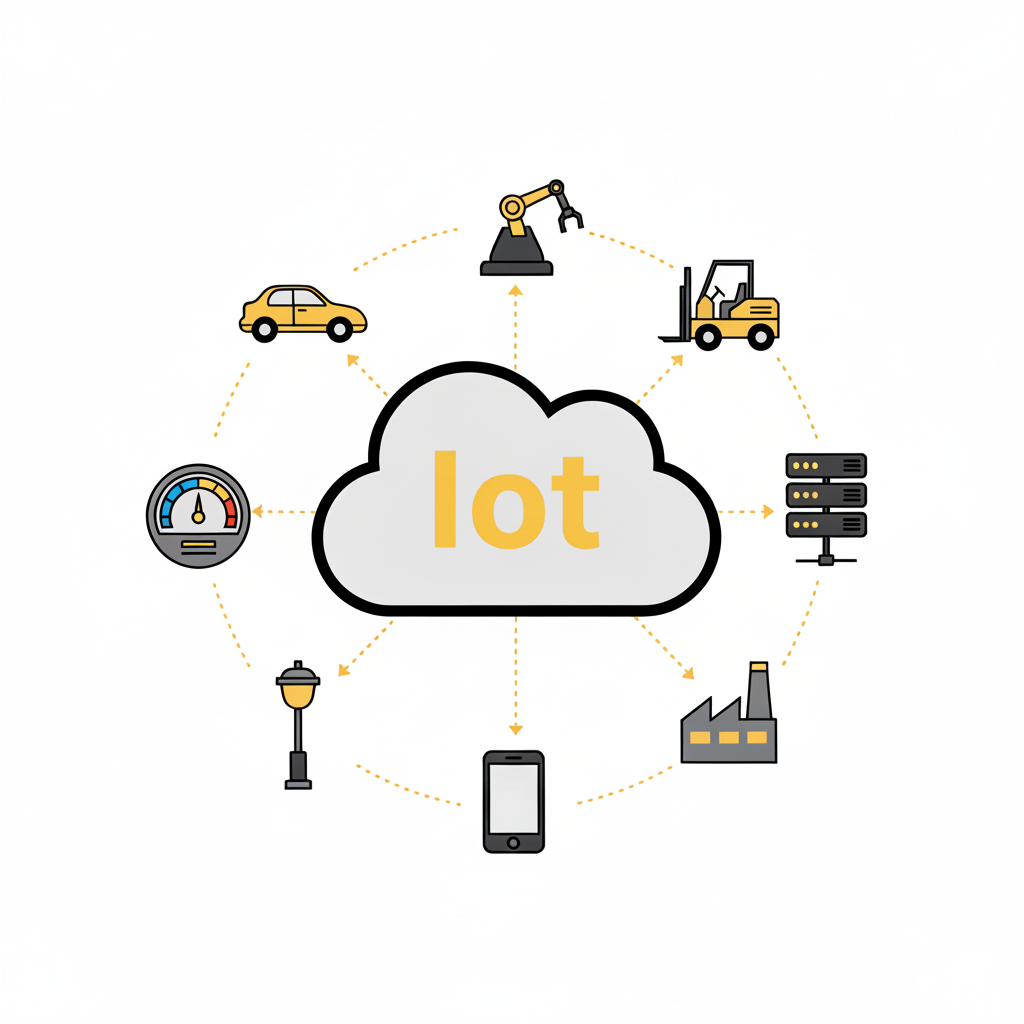
Every connected device feeds its data into Tagz in real time. But the step beyond monitoring is automation: the workflow engine can respond to any IoT event automatically, without anyone checking a gauge or watching a screen.
GPS Telematics
Live location, speed, idling, harsh braking, mileage. Accumulates against the asset to trigger maintenance work orders automatically.
Temperature Sensors
Cold-chain monitoring in transit and in storage. Excursion alerts fire immediately. The event is logged against the asset and the shipment.
Tank & Level Sensors
Fluid levels reported continuously from field assets. When a reading hits a configured threshold, a purchase order fires automatically. No one needs to check a gauge.
RFID Readers
Asset identity verified at handoff points. Dock arrival, custody transfer, and in-transit verification without manual scanning.
BLE Beacons
Asset location tracked within buildings and facilities. Know exactly where an asset is within a warehouse, hospital, or data centre floor.
Weight & Scale Machines
Load readings captured at dispatch. Verified weights feed directly into Cargo's load planning. No estimates, no overloading.
Dash Cams
Incident events recorded and logged against the vehicle asset record. Evidence preserved automatically at the moment of the event.
ELD Devices
Driver hours logged for compliance. Hours data attached to the asset record and available for reporting and audit.
Network & Control Systems
Power, cooling, and connectivity status for data centre assets. Anomalies trigger client notifications through their portal automatically.
IoT automation in practice
When a fuel tank drops below 20%, a purchase order fires. When a temperature excursion occurs in a refrigerated trailer, an alert reaches the operations team and the event is logged against the shipment. When a vehicle reaches its mileage threshold for service, a work order is created. When a data centre asset shows a power anomaly, the client is notified through their portal. This is the difference between an asset register that tells you what happened and an operational platform that acts on what is happening.
Rental & lease billing
The operational record that makes billing accurate.
For businesses that rent or lease assets to customers, Tagz provides the usage record that powers the invoice. Not an estimate. The actual data from the asset itself.
Deployment to customer account
When an asset is deployed, it links to the customer's account in Ryse with a recorded date, address, and reference. The deployment clock starts.
Usage captured from IoT
Mileage, operating hours, and sensor readings accumulate against the asset record during the rental period. The data is on the record, not reconstructed from memory.
Lyst applies the rate card
Lyst holds the pricing: rental rates, lease charges, and usage-based tiers. It reads the Tagz usage record as the source of truth for every calculation.
Flow issues the invoice
Flow handles the invoicing side: rental invoices, lease charges, and any adjustments. The full cycle from deployment to billing, connected.
Customer-facing visibility
Your clients see their assets. You control what they see.
For businesses that hold or manage assets on behalf of clients — co-location providers, equipment custodians, and managed service operators, Tagz supports customer-facing visibility through the Illuminate customer portal.
A client whose assets are held at a co-location facility can see live status, sensor readings, and event history for their assets without accessing the operator's operational platform. Instead of waiting for a report or calling to check status, clients have real-time access to the health of their assets at any moment.
The operator controls what is visible. Each client sees only their own data, scoped to their account, with no access to the operational platform or other clients' records.
See the Portal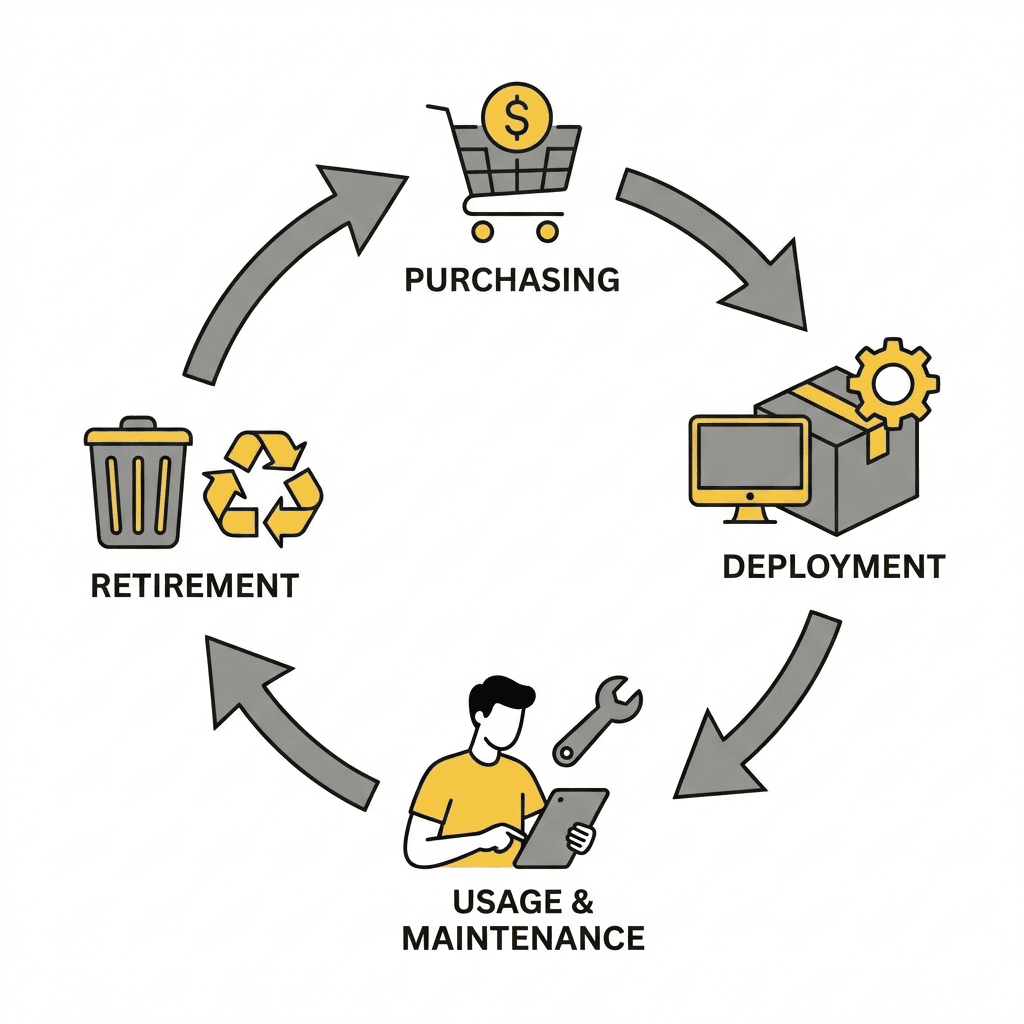
Platform advantage
Connected to every part of your operation.
Tagz is part of the Illuminate platform. The asset intelligence it builds connects directly to routing, customer management, invoicing, warehouse operations, pricing, and booking. Every connected product gets smarter.


Fleet intelligence that drives every dispatch decision
Vehicle specs defined in Tagz (payload, volume, temperature) constrain Cargo's route planning and load allocation. Live availability reflects service orders and maintenance. GPS mileage from Cargo automatically triggers Tagz maintenance work orders at configured thresholds.
Learn about Cargo →

Asset history on the customer timeline, automatically
Assets are linked to customer account records in Ryse. Deployed assets are visible on the account timeline. Custody transfers, service order completions, and asset events appear in the account history. Renewal and return triggers can fire automatically based on deployment dates and IoT data.
Learn about Ryse →

Rental invoices built from actual asset usage data
Equipment rentals, asset-based orders, and lease agreements managed through Flow. Automated workflows generate invoices and track rental periods. The complete Tagz asset record, including IoT usage data, is the source of truth for billing calculations.
Learn about Flow →

Automatic load plans from verified vehicle specs
Depot holds order data. Tagz holds verified vehicle specs. Together they generate automatic load plans, matching order volume and weight to the vehicles that can actually carry them. Asset utilisation is visible across warehouse operations. Idle asset time is surfaced for action.
Learn about Depot →

Rate cards applied to what the asset actually did
Lyst holds the rate cards for rental and lease assets. It reads the Tagz usage record (time deployed, IoT usage data, service history) and applies the correct pricing. Rental invoices reflect what the asset actually did, not what was estimated.
Learn about Lyst →
From booking to deployment in one connected cycle
Kart handles the booking and order front end. When a customer books an asset through Kart, Tagz receives the deployment record and the asset's availability status updates immediately. The booking-to-deployment cycle is connected end to end.
Learn about Kart →
How Tagz compares
Asset intelligence vs asset tracking
Most tools in this space are registers. Tagz is an operational platform.
Here is what that difference looks like in practice.
| Tagz | Asset Tracker EZOfficeInventory, Snipe-IT, Asset Panda |
CMMS / Maintenance Fiix, UpKeep, Limble |
|
|---|---|---|---|
| Core registry | |||
| Asset registry with unique Tag IDs | ✓ | ✓ | ✓ |
| Custom property schemas per asset type (no code) | ✓ | ◐ | ◐ |
| Asset classes with independent colour-coded status sets | ✓ | - | - |
| Three-level custody (account / internal user / external person) | ✓ | ◐ | - |
| Full event history on asset (every movement, status change, IoT event) | ✓ | ◐ | ◐ |
| Availability intelligence | |||
| Real-time availability status (reflecting service orders & maintenance) | ✓ | ◐ | ◐ |
| Asset availability visible before assignment or dispatch | ✓ | - | - |
| Asset reserved / committed status visible across teams | ✓ | ◐ | - |
| Service orders & custody | |||
| Closed-loop service orders (collect → process → return) | ✓ | - | - |
| Scan-based custody transfers with automatic reconciliation | ✓ | ◐ | - |
| Conflict detection: prevents cross-account custody errors | ✓ | - | - |
| Label templates with barcode / QR code (browser PDF printing) | ✓ | ◐ | - |
| Work orders & maintenance | |||
| Work orders with assignment & scheduling | ✓ | - | ✓ |
| Time-based scheduled maintenance triggers | ✓ | - | ✓ |
| IoT-triggered work orders (mileage / operating hours thresholds) | ✓ | - | ◐ |
| Date-property triggered work orders (licence / cert / warranty expiry) | ✓ | - | ◐ |
| IoT integration | |||
| GPS telematics: live location, mileage, idling, harsh braking | ✓ | - | ◐ |
| Temperature sensors with excursion alerts | ✓ | - | - |
| Tank & level sensors with automated purchase order trigger | ✓ | - | - |
| RFID, BLE, weight/scale, dash cams, ELD | ✓ | - | - |
| Workflow automation triggered by any IoT event | ✓ | - | ◐ |
| Rental & billing | |||
| Asset linked to customer account at deployment with date & address | ✓ | ◐ | - |
| IoT usage data (mileage, hours, sensor readings) on rental record | ✓ | - | - |
| Rental usage feeds rate card & invoice automatically | ✓ | - | - |
| Customer-facing portal: live asset status for clients | ✓ | - | - |
| Platform combinations (not available in any standalone asset tool) | |||
| Vehicle constraints + IoT layer feeding route planning (Cargo) | ✓ | - | - |
| Asset events on customer account timeline (Ryse) | ✓ | - | - |
| Usage-based invoicing from asset record (Lyst + Flow) | ✓ | - | - |
| Load planning with verified vehicle specs (Depot) | ✓ | - | - |
| Booking-to-deployment cycle connected (Kart) | ✓ | - | - |
◐ = available via third-party integration or add-on at additional cost
Pricing
We believe in transparent pricing with a promise.Lite
Track, assign, and monitor assets across your organisation. Visibility into state, ownership, and availability. No complexity.
Starting At
$25/mo
includes 1,000 assets
Start Free
Perfect For:
- Uniforms & PPE
- Office furniture & consumables
- Basic tools & equipment
- Low-value, high-volume assets
What's included:
- Asset registry with Tag IDs
- Custom asset types & classes
- Assignment & custody tracking
- Status & availability management
- Event history & audit trail
- Basic reporting
Standard
Manage mid-value assets with service orders, scan-based custody transfers, work orders, and scheduled maintenance.
Starting At
$35/mo
includes 100 assets
Start Free
Perfect For:
- Laptops & mobile devices
- Vehicles & fleet assets
- Office equipment & mid-value tools
- Rental & leased equipment
What's included:
- Everything in Lite
- Service orders with scan custody
- Label templates & QR / barcode printing
- Work orders & maintenance scheduling
- Date-property triggered work orders
- Rental & deployment records
Professional
Full asset intelligence: IoT sensor integration, automated workflow triggers, usage-based billing, and customer-facing asset visibility.
Starting At
$250/mo
includes 100 assets
Start Free
Perfect For:
- Vehicles with GPS & sensors
- Heavy machinery & industrial equipment
- Data racks & co-location assets
- Oil tanks & field infrastructure
- IoT-enabled assets of any kind
What's included:
Volume & commitment discounts
- Additional assets beyond the plan base are billed at a per-asset rate. Pricing available on request.
- Annual commitment discount applied on all plans.
- Multi-product pricing available when combining Tagz with other Illuminate products.
FAQ
Questions about Tagz, Illuminate's Asset Intelligence Platform.What is the difference between asset tracking and asset intelligence?
Asset tracking tells you what you own and where it is. Asset intelligence tells you what is happening to every asset right now: whether it is available, what it is costing over its lifetime, what revenue it is generating, and what the business should do next. Tagz connects every asset to the operational life of the business: the customer account it is deployed against, the IoT sensors reporting its condition, the service order managing its movement, and the workflow engine that fires automatically when a threshold is crossed.
What asset types can Tagz manage?
The range is deliberately broad: laptops, phones, servers, vehicles, cranes, refrigerated trailers, data server racks, apartments and building assets, oil tanks, uniforms, photocopiers on customer premises, any physical asset the business operates. The asset type changes. The intelligence layer does not. Asset types and their custom property schemas are configured entirely in settings, with no code required.
How do service orders work?
A service order manages the closed loop for an asset: collect from a verified customer account address, process through a warehouse or workshop, and return to a destination. Assets are scanned in and out at each custody transfer. Reconciliation is automatic. Conflict detection prevents cross-account errors. Service orders are printable for warehouse teams and searchable by order ID and external reference fields.
How does IoT-triggered maintenance work?
GPS mileage from Cargo's telematics accumulates against the vehicle asset record in real time. When the mileage hits a configured threshold (say, 60,000 km for an oil change), a work order is created automatically in Tagz without anyone monitoring the odometer. The same logic applies to operating hours, temperature excursions, tank levels, or any other IoT data stream. The asset monitors itself and the platform responds.
Can clients see the status of their own assets?
Yes. For businesses that hold or manage assets on behalf of clients — co-location providers, equipment custodians, managed service operators — the Illuminate customer portal gives clients real-time visibility into their own assets: live status, sensor readings, and event history. Clients see only their own data. The operator controls what is visible. Instead of waiting for a report or calling to check status, clients have on-demand access.
How does rental billing work?
When an asset is deployed to a customer, it links to their account in Ryse with a recorded deployment date, address, and reference. During the rental period, IoT data (mileage, operating hours, sensor readings) accumulates against the asset record. When the asset is returned, the usage record is complete. Lyst holds the rate cards and applies pricing against the Tagz usage record. Flow issues the invoice. No estimates, no reconstruction from memory. The asset tells you what it did.
How does Tagz connect with Cargo?
Tagz is the single IoT integration layer for the fleet. Vehicle specifications defined in Tagz (maximum payload, volume capacity, temperature capability) feed directly into Cargo's route planning and load management. Routes are never planned against a vehicle that physically cannot carry them. Live availability reflects current service orders and maintenance work orders. GPS mileage from Cargo automatically triggers Tagz maintenance work orders when configured thresholds are reached.
Is Tagz suitable for both small businesses and large operations?
Yes. Tagz scales from a small team tracking high-value equipment to large organisations managing mixed fleets of thousands of assets across multiple sites and ownership models. The Lite plan starts at $25/month for up to 1,000 assets. The Professional tier adds the full IoT layer, automated workflows, and usage-based billing for operations where asset intelligence drives real business decisions.
Asset intelligence starts with a single Tag ID.
Most businesses are sitting on an asset estate they can't fully see, can't accurately price, and can't act on in time. Tagz fixes that, starting day one.
Start Free Trial Book a DemoWe'd love to hear from you!
Whether you have a question, feedback, or just want to say hi, please don't hesitate to contact us through the form below. We'll get back to you as soon as possible.
Phone: (+971) 58 524 3821
Whatsapp: (+971) 58 524 3821
Whatsapp: (+971) 58 524 3821
Headquarters:
Dubai, United Arab Emirates
Locations:
Bangalore, India
Vancouver, Canada
Dubai, United Arab Emirates
Locations:
Bangalore, India
Vancouver, Canada