
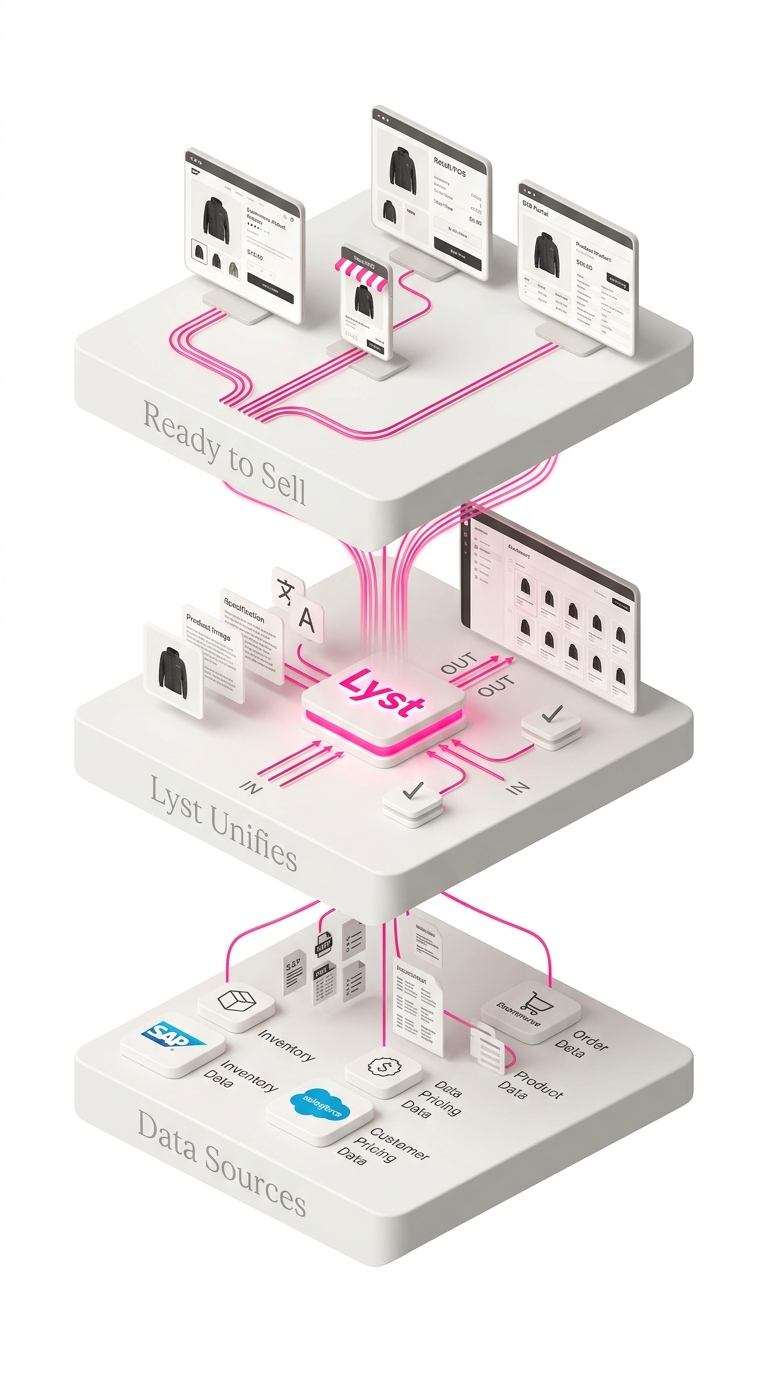
Lyst is Illuminate's Product Information Management (PIM) layer. It is the single product record that every channel and every connected Illuminate product reads from. Core capabilities: eight natively supported product types — Single/Individual (standard sellable item), Variant (one master product in multiple configurations, each with own SKU and pricing), Bundle (components inventoried at component level, consumed at order), Just in Time/JIT (Bill of Materials - no own stock, components consumed automatically at fulfilment), Raw (component inputs to JIT products, tracked in inventory), Internal (operational consumables and supplies, tracked but not sold), Rental/Time-based (assets deployed and billed by duration, distance, or usage), Provisioned (configuration questions at order time, connects to external system to provision). Five pricing mechanisms: Simple (flat price per unit), Slabs by quantity (volume tiered pricing resolved automatically), Time-based (per hour/day/week/month - rental), Distance-based (per km - delivery services), Custom rate cards (multi-variable: zone and weight for delivery, per operating hour/cleaning cycle/GB for asset rental, tiered structures). Per-client contracted rate cards applied automatically from the account record. Customer group price lists (distributors, retailers, trade accounts). Multi-currency pricing per product applied by transaction context. Catalogue capabilities: standard catalogues for distinct product sets, virtual catalogues (rules-based, dynamically maintained - tag a product and it updates every relevant catalogue automatically), third-party data source catalogues for external supplier feeds. Category-level attribute schemas cascade to every product in that category. Multi-language, multi-region, rich media per product and per variant. Units of measure with buy/sell conversion and physical specification distribution to Cargo and carriers. Inventory: per-type rules per product type (bundle component allocation, JIT BOM consumption, provisioned on demand), per-warehouse min/max thresholds with breach-triggered purchase orders, ML-driven replenishment from sales history and demand forecasts, seasonality rules, allow-negative toggle. Cross-channel promotions and discount codes with global redemption limits enforced consistently across all channels. ERP integrations: SAP, Oracle Fusion, Microsoft Dynamics 365, NetSuite, Odoo. Channel distribution: Kart (B2B/B2C storefronts), Mrkt (POS), Shopify, WooCommerce, Magento, WhatsApp/social commerce, API. Platform connections: Cargo (zone and weight rate cards at dispatch, delivery charge locked to record), Flow (order line pricing at creation from configured mechanism), Depot (SKU reference, inventory settings, receiving specs), Tagz (rental rate cards applied to GPS/IoT/scan verified usage data), Kart (per-account pricing at checkout), Mrkt (real-time product and price resolution at terminal). Pricing model: SKU-based tiers - Startup $100/mo (500 SKUs), Small Business $300/mo (2,000 SKUs, multiple catalogues), Business $600/mo (5,000 SKUs), Enterprise custom (5,001+ SKUs, virtual catalogues).
Trusted By











Built for how businesses actually work
Most product systems pick one model and expect the business to adapt. One product type. One pricing structure. One catalogue pattern. Every business that doesn't fit becomes a workaround.
Lyst is built the other way. The PIM layer that adapts to your business — your product types, your pricing models, your catalogue structure, your commercial reality. A construction equipment rental company does not price like a pharmaceutical distributor. A manufacturer does not structure products like a retailer. Lyst handles both, from the same platform.
One central product record, enriched once, distributed to every channel automatically. Change it once — every connected channel reflects it immediately.
Book a Demo
Eight native product types
Every product structure your business uses
No workarounds. No parallel systems for product types that don't fit. Every type is a first-class citizen with the right inventory behaviour, pricing logic, and fulfilment rules built in.
Single / Individual
One SKU, one price, one inventory record. The default for anything sold as a discrete item.
Variant
One master product, multiple configurations. Each variant has its own SKU, price, and media — managed from a single parent record.
Bundle / Kit
Two or more products sold as one unit. Components retain individual stock records. Allocation happens automatically at order.
Just-in-Time / BOM
Assembled from a Bill of Materials at fulfilment. Carries no stock — component quantities consumed automatically when ordered.
Raw Material
Component inputs to JIT products. Tracked in inventory, kept out of sales channels by default.
Internal
Operational supplies tracked through the business but never sold. Inventoried and replenished without appearing in any catalogue.
Rental / Time-based
Assets billed by duration, distance, or usage. Rate cards set in Lyst, applied automatically — verified usage data from Tagz.
Provisioned / Configurable
Configuration captured at order time. Connects to an external system to provision to the customer's exact parameters.
Product catalogue
Your complete product record, in one place
One record, enriched once, served to every channel. Product type set at creation — inventory, pricing, and fulfilment behaviour follow automatically.
Products & SKUs
Name, description, category, status, SKUs, tags, and media on one record. Status is the gate: one change removes from every channel at once.
Category-level attributes
Property schemas per category cascade to every product assigned. Define once — every new product inherits immediately.
Rich media & variants
Photos and videos per product and per variant, served to every channel that supports them.
Multi-language & multi-region
Product content in multiple languages on one record. Multi-currency pricing applied by transaction context.
Units of measure
Buy in cases, sell in eaches, plan by pallets. Conversion factors, physical specs, and per-unit channel flags from one record.
ERP integration
Connect to SAP, Oracle Fusion, Dynamics 365, NetSuite, or Odoo. Pull in, enrich in Lyst, sync back.


Pricing & rate cards
Every commercial model your business runs
Pricing configured per product to match its commercial reality. One change in Lyst applies across every connected channel immediately.
Simple pricing
Flat price per unit, per currency. The default for anything priced straightforwardly.
Quantity slabs
Tiered volume pricing — correct tier resolved automatically from order quantity. No manual lookup.
Time-based pricing
Per hour, day, week, or month. For rental assets and deployed products.
Distance-based pricing
Per kilometre or distance unit. Rate cards applied at dispatch in Cargo.
Custom rate cards
Multi-variable structures — zone and weight for delivery, per operating hour for rentals, tiered and banded pricing.
Per-client & group pricing
Contracted rates applied from the account record. Distributor, retailer, and trade pricing applied at checkout automatically.
Catalogues & channels
One catalogue. Every channel, in sync.
Three catalogue models for every operating structure. New channel or region: define the rules, point it at Lyst, done.
Standard catalogues
Independently managed product sets per business line, channel, or brand — each with its own lifecycle and channel assignments.
Virtual catalogues
Rules-based sets derived from the master, maintained automatically. Tag a product — every relevant catalogue updates immediately.
Third-party data sources
External supplier feeds connected as catalogues. Staged and cached alongside owned products — one interface for all.
Channel distribution
Kart, Mrkt, Shopify, WooCommerce, WhatsApp, and API — all fed from Lyst without duplication.
Structured attributes
Category schemas drive faceted search, API queries, and AI-powered product matching across the catalogue.
Inventory intelligence
Stock behaviour that matches your products
Inventory configured per product type. Replenishment, thresholds, and seasonality rules run from Lyst — Depot executes, Flow consumes.
Per-type inventory rules
Bundle availability derives from its lowest-quantity component. JIT carries no stock — availability calculated from BOM components in real time.
Min/max thresholds
Per-product and per-warehouse thresholds. A breach fires a purchase order automatically — correct supplier, correct unit, no manual intervention.
ML-driven replenishment
Driven by actual sales history and forecasted demand. The system learns what sells, when, and in what quantities.
Seasonality & demand rules
Thresholds auto-adjust ahead of demand cycles. Per-warehouse calibration — fast movers at one location don't drive replenishment at another.
Backorder & zero-stock control
Allow-negative toggle controls whether a product can be ordered at zero stock. Hard stock control enforces the limit at order entry.
Warehouse & Depot alignment
Inventory settings in Lyst drive Depot behaviour. Discontinued in Lyst means removed from the warehouse automatically.
Platform connections



 Book a Demo
See the Platform
Book a Demo
See the Platform
The product layer every Illuminate product reads from
Lyst is not just a catalogue — it is the commercial and pricing record that every connected product runs from. One update in Lyst. Every connected system reflects it at the next transaction.
Platform advantage
What each connection makes possible
Lyst is where product and pricing intelligence is created. These are the business outcomes when the rest of the platform reads from it.

Storefront pricing applied from catalogue, not managed per buyer
B2B and B2C storefronts on Kart serve products, prices, and variants directly from Lyst. A distributor sees distributor pricing, a retailer sees retailer pricing — applied automatically at checkout based on who is authenticated. No storefront configuration per buyer.
Learn about Kart →
Every order line priced at creation — no manual rate lookup
Flow references Lyst products as order line items and resolves the correct pricing mechanism at the point of creation — Simple, Slabs, Time-based, or Custom rate card. Per-client contracted rates applied from the account record automatically.
Learn about Flow →
Delivery charges from rate cards, locked to the record at dispatch
Zone and weight rate cards configured in Lyst are applied automatically when a shipment is created in Cargo. The delivery charge is locked to the record at that moment — month-end invoicing uses the recorded charge, not a retrospective calculation.
Learn about Cargo →
Inventory rules drive warehouse behaviour — not spreadsheets
Every SKU in Depot traces to a Lyst record. Inventory settings in Lyst define how that SKU behaves in the warehouse — whether it is tracked, what the reorder point is, how it is received. Discontinued in Lyst means removed from Depot automatically.
Learn about Depot →
Rental invoices built from verified usage data, not estimates
Rental and lease pricing lives in Lyst. The usage data those rate cards price against comes from Tagz — GPS mileage, IoT operating hours, deployment scan events. Together with Flow, the complete billing cycle runs automatically: Tagz records what happened, Lyst defines what to charge, Flow raises the invoice.
Learn about Tagz →
Every terminal resolves the correct price in real time
Every item scanned or selected at a Mrkt terminal resolves to the correct Lyst product and price in real time. Multi-currency by terminal location. Price list by account type at the same terminal. A price change in Lyst applies at the next transaction across every terminal simultaneously.
Learn about Mrkt →
How Lyst compares
Lyst is the only PIM built for operational businesses.
The question is not just which PIM manages the most product data. It is which product system can handle the commercial and operational reality of how a business actually runs.
| Lyst | PIM systems Akeneo, Salsify, Pimcore |
E-commerce catalogues Shopify, WooCommerce |
ERP product masters SAP, Oracle, Dynamics |
|
|---|---|---|---|---|
| Product types | ||||
| 8 native product types (Single, Variant, Bundle, JIT/BOM, Raw, Internal, Rental/Time-based, Provisioned) | ✓ | - | - | ◐ |
| JIT / BOM component consumption at fulfilment | ✓ | - | - | ◐ |
| Bundle component-level inventory tracking | ✓ | - | - | ◐ |
| Provisioned products with configuration at order time | ✓ | - | - | - |
| Pricing | ||||
| Multiple pricing mechanisms (time, distance, slabs, rate cards) | ✓ | - | - | ◐ |
| Per-client contracted rate cards applied automatically | ✓ | - | - | ◐ |
| B2B customer group price lists at checkout | ✓ | - | ◐ | ◐ |
| Multi-currency by transaction context | ✓ | ◐ | ◐ | ✓ |
| Catalogue | ||||
| Virtual catalogues — rules-based, dynamically maintained | ✓ | ◐ | - | - |
| Category-level attribute schemas cascading to products | ✓ | ✓ | - | ◐ |
| Multi-language, multi-region from one record | ✓ | ✓ | ◐ | ◐ |
| Units of measure with buy/sell conversion | ✓ | - | - | ✓ |
| Inventory & operational intelligence | ||||
| Per-type inventory behaviour natively | ✓ | - | - | ◐ |
| ML-driven replenishment from sales history | ✓ | - | - | ◐ |
| Cross-channel promotions with unified redemption visibility | ✓ | - | ◐ | - |
| Platform connectivity (not available in any standalone PIM) | ||||
| Native TMS connection — delivery rate cards applied at dispatch | ✓ | - | - | - |
| Native WMS connection — warehouse behaviour driven by Lyst | ✓ | - | - | - |
| Native POS — real-time product and price resolution at terminal | ✓ | - | ◐ | ◐ |
| Asset rental billing — rate cards applied to verified usage data | ✓ | - | - | - |
| Self-service configuration — no IT involvement required | ✓ | ◐ | ✓ | - |
◐ = available via additional configuration, custom development, or third-party integration at extra cost
Pricing
SKU-based pricing that gets cheaper as your catalogue grows. Every tier includes all product types, all pricing mechanisms, and native platform connectivity.Startup
For businesses getting started: couriers, asset rental operations, small retailers, and any business with a straightforward catalogue. Single catalogue, all features included.
Up to 500 SKUs
$100/mo
per month
Start Free
Perfect For:
- Couriers & service product catalogues
- Small retailers & boutique wholesalers
- Asset rental businesses
- Single-channel operations
Small Business
For growing businesses with an expanding catalogue. Retailers adding product lines, distributors building out their range, and businesses managing more complex pricing structures.
Up to 2,000 SKUs
$300/mo
per month
Start Free
Perfect For:
- Multi-category retailers
- Regional distributors
- B2B & B2C parallel channels
- Multiple divisions or brands
Business
For established businesses managing a broad catalogue across multiple categories, channels, and customer groups, running Lyst as the product and pricing layer across several connected Illuminate products.
Up to 5,000 SKUs
$600/mo
per month
Start Free
Perfect For:
- Mid-size retailers & distributors
- Manufacturers with complex product types
- Multi-channel operations at scale
- Businesses running multiple Illuminate products
Enterprise
For businesses with catalogues exceeding 5,000 SKUs, multiple ERP systems, virtual catalogue requirements, and complex multi-region or multi-brand operating structures.
5,001+ SKUs
Let's talk
custom pricing
Contact Us
Perfect For:
- Large retailers & distributors
- Multi-ERP & multi-region enterprises
- Multiple brands or operating divisions
- Complex channel distribution requirements
Discounts on every plan
- Bundle discount when you subscribe to more than one Illuminate product
- Annual prepayment discount available on all plans
- Multi-product pricing available when combining Lyst with other Illuminate products
Frequently asked questions
Everything you need to know about Lyst before your first demo.
What is Lyst?
Lyst is Illuminate's Product Information Management (PIM) layer. It is the single product record that powers every channel a business sells through — B2B and B2C storefronts, POS terminals, order management, delivery pricing, and warehouse operations — from one central place. Change it once and every connected channel reflects it immediately.
Does Lyst work without an ERP?
Yes. Lyst works equally well as a standalone catalogue with no ERP connected. It handles products, pricing, inventory, and channel distribution from day one. ERP integration is available when needed — for one ERP or many — but it is not a requirement to get started.
How does Lyst handle B2B pricing?
Lyst supports per-client contracted rates and customer group price lists natively. A distributor, a retailer, and a trade account each see the pricing structure configured for their account type, applied automatically at checkout or order creation. No manual rate lookup, no pricing by spreadsheet.
What are virtual catalogues?
Virtual catalogues are rules-based product sets derived from the master catalogue. You define rules — by category, tag, product type, or any combination — and Lyst maintains the catalogue automatically. Tag a product as a fast mover and it appears in the WhatsApp catalogue immediately. Point a new channel at an existing virtual catalogue and it is live with no manual curation. Available from the Enterprise tier.
How does Lyst connect to the Illuminate platform?
Every Illuminate product that touches a product or a price reads from Lyst. Kart serves product pages and applies pricing at checkout from Lyst. Flow prices every order line at the point of creation. Cargo calculates delivery charges from Lyst rate cards at dispatch. Depot manages warehouse stock against Lyst SKUs and inventory settings. Tagz applies Lyst rate cards to verified asset usage data for rental billing. Mrkt resolves every terminal transaction against the correct Lyst price in real time.
What makes Lyst different from Akeneo or Salsify?
Standalone PIMs manage product content. Lyst manages commercial and operational reality. Eight product types with native inventory behaviour. Five pricing mechanisms from simple flat rates to multi-variable rate cards. Per-client B2B price lists. ML-driven replenishment. Native connections to TMS, WMS, POS, and e-commerce — not integrations that need to be built, connections that already exist. Comparable standalone enterprise PIMs typically cost $35,000 to $100,000 or more per year and require separate integration projects to connect to any operational system.
Can I manage multiple brands or regions from one account?
Yes. Multiple catalogues let you manage distinct product sets for different divisions, brands, or channels independently. Virtual catalogues create channel-specific and region-specific product sets from the master catalogue without duplication. Multi-language product content and multi-currency pricing are stored on a single product record and applied automatically by context.
What happens when I update a product or price in Lyst?
The change applies to every connected channel immediately. A price updated in Lyst is the price at the next transaction — in Kart, in Mrkt, in Flow, in Cargo. A product deactivated in Lyst disappears from every channel simultaneously. There is no channel-by-channel update process.
How much does Lyst cost?
Lyst is priced by catalogue size — specifically the number of active SKUs under management. Plans start at $100/month for up to 500 SKUs (Startup), $300/month for up to 2,000 SKUs (Small Business), and $600/month for up to 5,000 SKUs (Business). Enterprise pricing is custom for catalogues above 5,000 SKUs. Every plan includes all product types, all pricing mechanisms, and native platform connectivity. The per-SKU cost decreases at each tier — growth is never penalised.
Ready to see Lyst in action?
Book a live demo and we will walk through your product structure, your pricing models, and the platform connections that apply to your business.
Request a Demo Start Free TrialWe'd love to hear from you!
Whether you have a question, feedback, or just want to say hi, please don't hesitate to contact us through the form below. We'll get back to you as soon as possible.
Phone: (+971) 58 524 3821
Whatsapp: (+971) 58 524 3821
Whatsapp: (+971) 58 524 3821
Headquarters:
Dubai, United Arab Emirates
Locations:
Bangalore, India
Vancouver, Canada
Dubai, United Arab Emirates
Locations:
Bangalore, India
Vancouver, Canada