
What Operations Actually Means
Every few weeks somebody asks us what business operations actually means. It is a fair question, and most of the definitions out there are no help at all.
Look it up and you get a list of departments. Procurement, production, inventory, distribution, finance. Tidy boxes, each with a heading and a head of. None of it is wrong. It is just not what anybody in the building actually does all day.
The horizontal view, and what it is good for
That list is roughly how an ERP sees a company, and it is a sensible way to see one. Finance here. Sales there. Warehouse at the back. Everything in its own column, everything reconcilable at the end of the month.
If you need to know what the business spent, what it owes, what it owns and what it is worth, that is exactly the view you want. We are not about to tell you it is the wrong way round. It is the right way round for the job it does.
It just does not describe the work.
Because the work does not travel across those columns. It travels down through them, and it looks rather more like this:
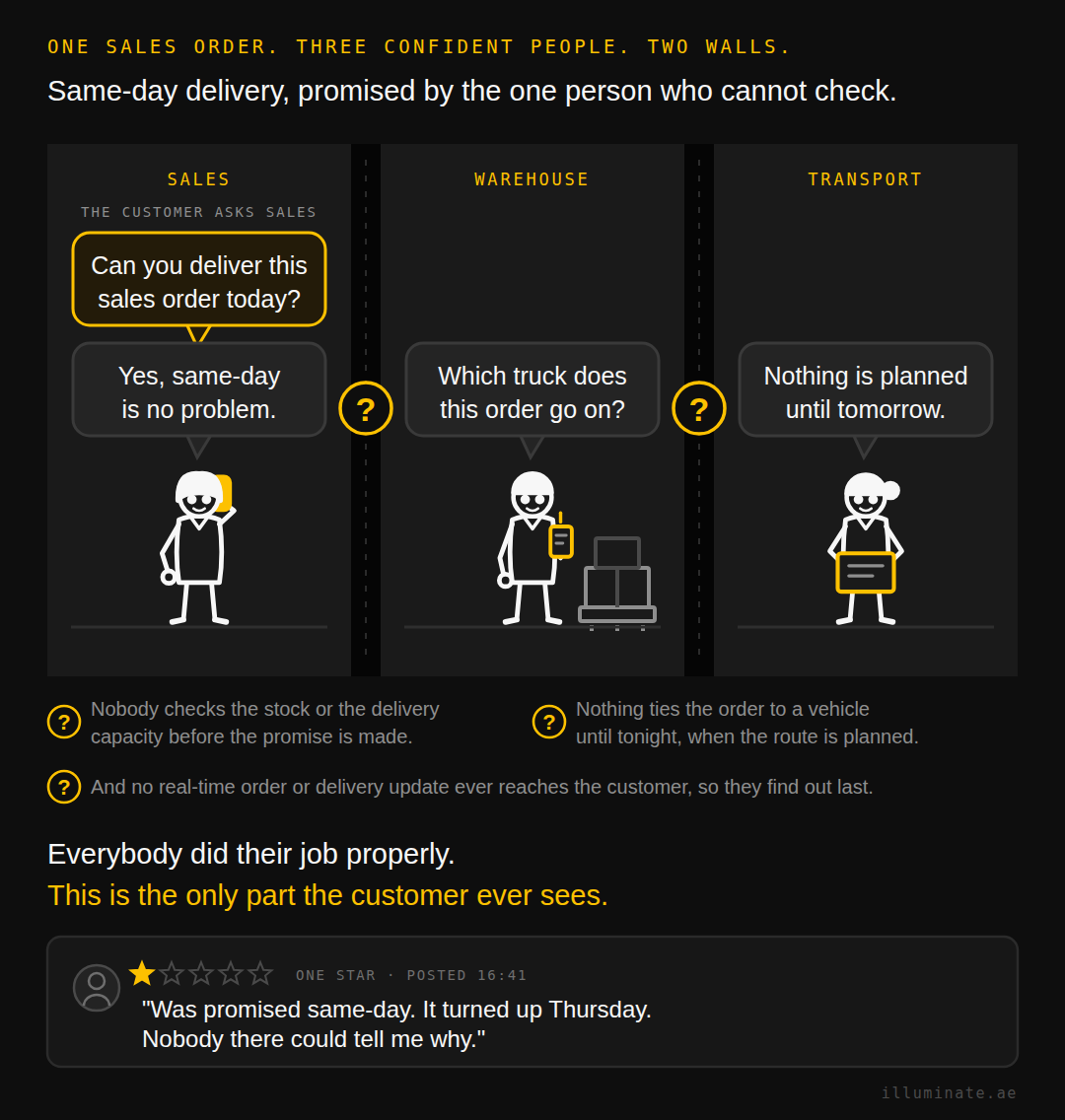
Every box in that picture has somebody's name on it. Every question mark does not.
Nothing ever shipped because of a department
Things ship because of a sequence. A chain of small decisions running downwards through all of those tidy columns, each one depending on the one before it, none of them owned by a single box on the chart.
Can we accept this order at all. Is the customer good for it, or are they over their limit. Do we have the stock, and if we do, can we hold it before somebody else sells it. Does it need making or assembling first. Who picks it. What does it go on. Which vehicle, which driver, in what order. And when a third of it comes back next week, what happens then.
That is operations. Not a department. A sequence of questions that has to be answered correctly, in order, before anything reaches anybody.
It is also where businesses actually fail. Not inside the functions, where people are generally competent and well measured, but in the handovers between them - the arrows on anybody's process diagram - where nobody owns the outcome and no single system covers the ground.
Worth being precise about why. Nobody involved in a handover is doing their job badly. Everybody is answering correctly from inside their own box, using the system they were given, against the number they are measured on. The work still comes out wrong, and it usually surfaces hours later, physically, in front of a customer.
Why solving the stages apart costs you
This is not just a nice way of describing things. There is evidence that the sequence has to be solved as a sequence.
The most useful study we have found on internal coordination looked at 617 manufacturers across five Chinese cities and split integration into three kinds: internal, with customers, and with suppliers. The result is not the one the industry usually sells you.
Internal integration was directly related to both operational and business performance. Supplier integration, on its own, showed no direct relationship to either. And the authors are explicit that internal integration is the foundation the other two are built on.
Which is worth sitting with for a second, because almost every supply chain conversation is about the external stuff. Portals for customers. EDI with suppliers. Visibility up and down the chain. All useful. All apparently built on a floor that most businesses have not poured yet.
The second piece of evidence is narrower and more concrete. Researchers took two warehouses belonging to a large Dutch grocery retailer and planned the picking and the delivery routing as one problem rather than two. Savings came out between 9 and 11%, and integrated planning beat every other intervention they tested, including simply giving the warehouse more staging space.
Here is the detail most people would leave out. Some of that saving comes at the expense of routing, which got roughly 2 to 3% more expensive. The whole got better while one of the parts got worse.
Which is the entire argument in one line. No warehouse manager optimising a warehouse would ever accept a change that made routing worse, and no transport manager would propose one. You can only see that trade if you are looking at the sequence rather than the stages.
Two stages. Solved together instead of in sequence. Now imagine the same question asked of eight.
So where does the ERP fit?
Underneath everything above, there is usually a nervous question waiting: are you telling me to replace my ERP?
No. Keep it. We are not going to stand here and tell you to rip out the one system in the building everybody already agrees on.
Your ERP owns the ledger, the statutory reporting, the payroll, the consolidated view of the business. Those are real jobs and it is the right system for them. It was built to record what happened, accurately and in a form an auditor will accept.
Operations is a different problem. It is not about recording what happened. It is about deciding what happens next, in the next four minutes, on a loading bay, with a driver waiting. Those two things want different data, at different speeds, in different shapes.
A vertical cut through horizontal layers is not a smaller version of those layers. It is a different axis. That is why the two coexist rather than compete, and why the interesting question is never which system wins, but whether the sequence can actually reach the people doing the work, in time to be of any use.
The bit that matters for what comes next
There is a version of this argument that sounds like housekeeping. Tidy your data, connect your systems, everyone feels better. That is not the point.
The point is that everything arriving next needs the sequence to exist before it can do anything useful.
Automation needs to know what to do and in what order. Anything that can connect, whether that is a robot, a conveyor, a sensor on a vehicle, a reader on a door or whatever turns up in three years, has to take its instructions from the same queue people work from. A machine cannot infer the running order from a conversation two people had in a corridor.
And AI has the same dependency, which is why so many AI projects disappoint. Most of them are not AI problems. They are data problems in a fashionable hat. If the operational picture lives in six systems and a spreadsheet, no model is going to rescue it, because the model has nothing consistent to reason about. Clean, connected, real-time operational data is the boring prerequisite nobody sells tickets to.
Get the sequence right and both of those become straightforward. Get it wrong and they stay permanently six months away.
How this runs on one platform
Illuminate is built along that vertical rather than across the horizontal.
Ryse CRM holds the account, so the credit position and the history are there at the point the order arrives. Flow OMS takes the order from whichever channel it came through and decides what happens to it, including splitting it across warehouses or pushing it to a supplier to drop ship. Lyst PIM carries the catalogue and the contracted pricing, so the price is right the first time. Depot WMS manages the stock, the reservation, the picking and the load plan, and refuses to commit a load that breaks a compliance rule. Tagz AMS tracks the vehicles, the equipment and the sensors, and knows whether the equipment is serviceable today. Cargo TMS runs the dispatch, the driver and the delivery.
They run standalone if that is all you need. What makes the sequence work is that they share one data model, so a delivery confirmed in one product updates the inventory, the invoice and the customer's order in the others without an integration project in between. Anything outside connects to that same layer in real time, which is where your ERP, your carriers and your marketplaces come in.
The short version
Operations is not a department. It is the sequence of decisions that has to run correctly, in order, for anything to reach a customer.
An ERP looks across that sequence and records it. Something has to run down through it. The research says the internal handovers matter more than the external ones, and that stages solved together beat stages solved apart.
Most businesses have bought plenty of software for the boxes. Very few have bought anything for the arrows.
Frequently asked questions
What does business operations actually mean?
Business operations is the sequence of decisions and actions required to turn an order into a delivered product or service. It spans order acceptance, credit, stock availability and reservation, production or assembly, picking and packing, equipment, dispatch and delivery, and returns. It is usually described as a set of departments, but the work happens in the sequence that runs through them.
What is the difference between business operations and an ERP?
An ERP is organised horizontally, by function, and is built to record transactions accurately for reporting, finance and audit. Operations runs vertically, through those functions, and is about deciding what happens next in real time. They answer different questions and generally coexist rather than replace one another.
Why do operations fail between departments rather than inside them?
Because functions are staffed, owned and measured, while the handovers between them usually are not. A handover has no single owner, no dedicated system and rarely a metric, so problems there are invisible until something physical goes wrong, such as a truck leaving late.
Does AI fix operational problems?
Not on its own. AI needs consistent, connected, real-time operational data to reason about. Where that data is fragmented across several systems, AI tends to amplify the inconsistency rather than resolve it. Connecting the operational sequence is a prerequisite for AI rather than a consequence of it.
References
- Flynn, B.B., Huo, B. and Zhao, X. (2010). The impact of supply chain integration on performance: a contingency and configuration approach. Journal of Operations Management, 28(1), 58-71.
- Rijal, A., Bijvank, M. and de Koster, R. (2023). Dynamics between warehouse operations and vehicle routing. Production and Operations Management, 32(11), 3575-3593. Open access.
More in this series
If the sequence is the argument, the loading dock is where you can watch it break. A few shorter reads that go a level down.
- What WMS and TMS Integration Actually Changes on the Loading Dock - what happens when two of those stages finally agree with each other.
- Pick by Order, Batch, or by Truck - three ways to pick, and what each one needs before it will work.
- You Don't Need More Software. You Need One Version of the Truth. - the same argument, from the data side.
Talk to us about the sequence in your business
For media inquiries, please contact:
contact@illuminate.ae