
Why the Last Stop Is Loaded First
A truck has one door.
Sounds obvious. It isn't, and it quietly decides how the whole day goes.
Everything that goes in has to come back out through that same door, and it comes out in the reverse of the order it went in. So the goods for your last drop of the day need to go on the truck first, right up at the front. The first drop goes on last, by the door, ready to come straight off.
Load it that way and the driver opens up at every stop and what he needs is right there.
Load it the other way round and, well. Let's talk about that.
What it actually feels like
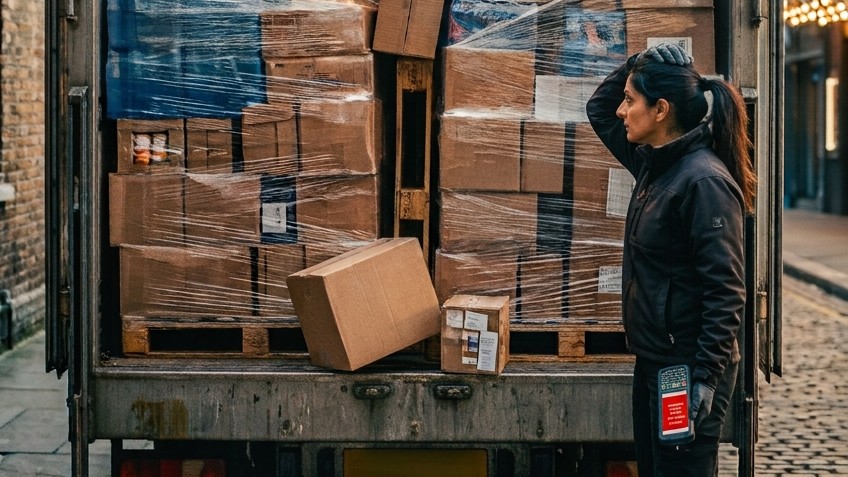
Picture your driver at stop three.
He opens the doors and the pallet he wants is somewhere behind four that he doesn't. So he climbs in, shifts them out, finds his one, puts the rest back. Ten minutes gone. Then he does the whole dance again at stop four. And stop five.
On a twelve-drop day that's the best part of an hour spent moving other people's deliveries around. And it piles up at the back end of the route, which is exactly where the tightest time slots tend to sit. Not ideal.
It's not just the clock, either. Stuff that gets handled five times gets damaged about five times as often, and goods packed to survive a motorway aren't necessarily packed to survive being restacked on a kerb in the rain. None of which shows up on a report anywhere, because nobody's logging "moved it out of the way again".
Mostly though, it's just a rotten way to spend a shift. Drivers notice. It's one of the quieter reasons the job is hard to staff.
Here's the bit I enjoyed
You might assume this is dock folklore. Something the old hands know.
It isn't. There's a whole corner of operations research devoted to it, and it has a properly serious name: the last-in-first-out loading constraint. People write papers about this.
And the reason they treat it as a hard rule rather than a nice-to-have is wonderfully practical. In a 2020 study on partial last-in-first-out loading constraints, Chagas, Toffolo, Souza and Iori point out that shuffling things around inside the vehicle is often just not allowed, because the goods "may be large, heavy and/or fragile or dangerous to handle".
So: researchers with models, and a driver who worked it out in his first week. Same answer. There's something rather good about that.
One more thing from that paper, and it's the interesting bit. Loading in strict reverse order actually makes the route slightly worse, because the planner loses some freedom to sequence the stops. Let the crew rearrange a little, and you get shorter routes but more handling.
Which means there's a real trade to make here. Just make it on purpose, rather than finding out about it at stop three.
So why does it go wrong?
Not because anyone's careless. Genuinely.
The stop order lives in the transport system. The people loading the truck work in the warehouse. Two different systems, and somebody has to carry that sequence across the gap by hand: a printout, a quick word at six in the morning, a message on the way in.
Usually nobody does.
So the truck gets loaded in the order things came off the shelves. Which, if that's the only order anybody ever handed you, is a completely reasonable thing to do.
That's worth sitting with for a second, because the instinct when a truck comes back late is to go looking for someone to blame. There's nobody. The loader didn't ignore the route. He was never shown it.
What good looks like
The warehouse gets the load plan as an instruction, not a puzzle. This pallet first, that one last, this one on the left.
Your loader doesn't need to know the route. Doesn't need to know which customer is which, or why Tuesday runs differently from Thursday for reasons nobody can quite remember any more. That's a lot to carry around in your head, and heads take holidays.
Put the sequence in the system and somebody on their first shift loads the truck properly. That's the whole goal, really.
How this runs on one platform
Depot WMS works out the loading sequence for every vehicle on every run, built from the packing data and the dispatch route together. The warehouse team gets the plan in load order: what to stage first, what goes on last, where each pallet sits based on the order of the stops.
And because the dispatch plan and the picking queue aren't in separate systems, nobody has to carry anything anywhere. Committing the plan creates the warehouse picking work and the driver trips in Cargo TMS at the same moment. The order the dock loads to and the order the driver delivers in come from the same calculation, because they are the same calculation.
Frequently asked questions
Why is the last stop loaded first on a delivery truck?
Because a truck is unloaded in the reverse of the order it was loaded, through one door. The freight for the final stop has to go in first, deepest in the vehicle, so the first stop's goods end up at the tailgate and come off first.
What is LIFO loading?
Last-in-first-out loading is the rule that whatever went in last has to come out first. Vehicle routing research treats it as a hard constraint because rearranging large, heavy or fragile goods inside a vehicle is often impractical or unsafe.
Does loading in reverse stop order make the route worse?
Slightly, yes. Strict LIFO takes away some freedom to sequence stops efficiently. Research on partial LIFO constraints shows that allowing a bit of rearrangement gives you shorter routes in exchange for more handling, so it's a trade worth making deliberately.
Why does the warehouse load trucks in the wrong order?
Almost always because nobody gave them the right order. The loading sequence comes from the delivery route, which lives in the transport system, while the loading happens in the warehouse. If the two don't share a plan, the dock falls back on the order goods came off the pick face.
References
- Chagas, J.B.C., Toffolo, T.A.M., Souza, M.J.F., & Iori, M. (2020). The double travelling salesman problem with partial last-in-first-out loading constraints.
- Invar Systems - Case Study: Reverse Stop Route Truck Fulfillment.
This is one piece of a bigger picture.
Load sequence is one of two places where the gap between a warehouse system and a transport system shows up physically, on the floor, in front of a customer. The full piece covers both, along with the research on what keeping them apart actually costs.
Come and talk to us about closing that gap
For media inquiries, please contact:
contact@illuminate.ae