
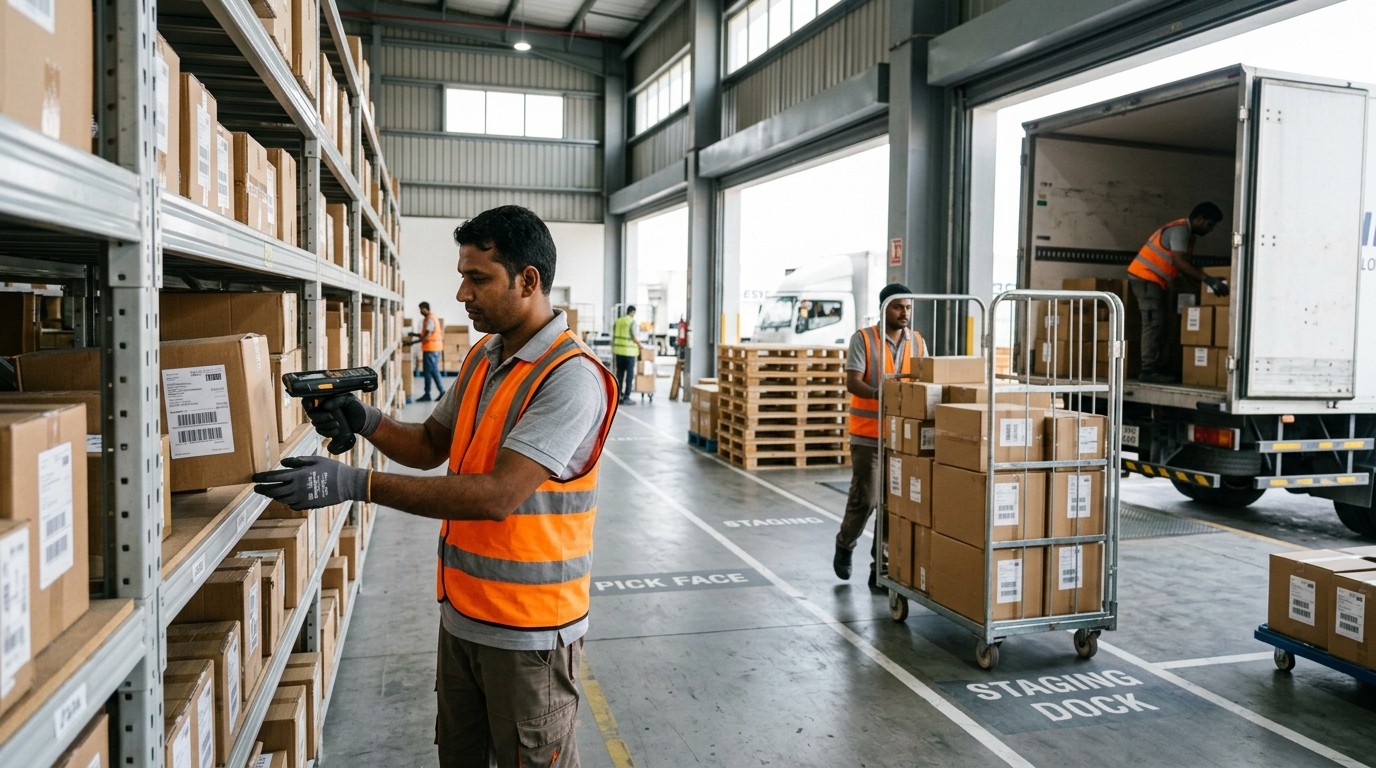
Pick by Order, Batch, or by Truck
Ask most people how a warehouse decides to pick and you'll get an answer about aisles. Pick face layout. Travel distance. Scan rates. All of it inside the building, all of it sensible.
And all of it missing the thing that actually decides whether any of it works.
The picking model you run sets how much you need to know from the transport plan, when you need to know it, and - in one case - whether the warehouse can function at all without it. Three common models. Three completely different answers.
This is the detail underneath a bigger argument we made recently: that warehouse and transport get optimised apart, and the operation quietly pays for it. Here's where that shows up at the pick face.
One order, one person, one list
One order. One operative. One pick list, sequenced to walk them the short way round. Scan as you go, and you're finished when the list is.
It's the model for hyperlocal, same-day and express work, where a drop might be a single order and the van carries a handful of stops. It's also where nearly everyone lands at low volume, because it's simple and it's genuinely hard to get wrong.
What it needs from transport: timing, not sequence.
There's barely a load order to worry about here. What matters is when you start.
Start too early and the goods sit in staging taking up space and getting older, in a business where older usually means worse. Start too late and the driver is stood about waiting on you, which is expensive, because the driver is normally the thing you have least of.
So the useful signal isn't the route. It's where the van actually is. Trigger the pick when the driver is twenty minutes out and the order is ready as they pull in, rather than having sat in staging since six in the morning.
Batch picking: walk once, sort it out later
Lines from a lot of orders, collected in a single pass. Walk the aisles once for twenty orders instead of twenty times. At volume that saving swamps everything else you could possibly optimise. Items get assigned to their parent orders as they're scanned, then sorted back out at the pack station or in a staging lane.
The sheer size of that saving is why the model exists at all. A review of the order picking research in the European Journal of Operational Research puts the cost of order picking at as much as 55% of total warehouse operating expense, with travel the dominant slice of a picker's time. Take out travel and you're taking out the single biggest cost in the building. Of course people batch.
What it needs from transport: the build order for staging.
Here's the bit that catches everyone out. Batch picking doesn't get rid of the sequencing problem. It moves it somewhere else and rather hopes you don't notice.
Your pick face is now optimised for walking. Which means goods come off it in an order that has nothing whatsoever to do with how they're leaving the building. That sequencing still has to happen. It's just happening later now, in staging, and staging has to be laid out in the order the loads get built.
And you cannot work that order out from inside the warehouse. It comes from the route and the vehicle assignment. Lay your staging out by order number, or by customer, or by whatever seemed reasonable on the day, and somebody is re-handling the lot before the truck can be loaded properly. Re-handling being the exact thing batch picking was supposed to save you from.
Picking by truck, and the bit that breaks
Pick lists per order, per vehicle. The warehouse works one truck at a time, so a vehicle's freight arrives at the dock together and in the order it's going on.
This is what multi-stop distribution actually runs on. It's also the model that breaks a disconnected operation outright, and not gently.
What it needs from transport: the plan itself. First.
"By truck" isn't a category the warehouse can invent. Nothing in the order data says which vehicle an order belongs to. That grouping gets created by the dispatch plan, at the moment capacity, compliance and route are worked out together.
So until the plan exists and has landed in the warehouse system, the right pick list cannot be produced. Not produced in a slightly worse order. Not produced a bit late. It cannot be produced, because the thing it groups by doesn't exist yet.
Which is worth sitting with for a second. In a truck-based operation the transport plan isn't an input that makes the warehouse's job better. It's the precondition for the warehouse having a correct job at all.
The word everybody's missing
One more piece of precision, because nearly every description of this gets the unit wrong. Including the simplified version I've just given you.
The day's orders don't map neatly onto the day's vehicles. They never have.
A big replenishment can sail straight past what any one vehicle can carry, so it gets split across loads. Compliance forces splits that capacity alone wouldn't: food and chemicals can't share a trailer, hazardous goods might need isolating, and a third-party logistics client may be contractually entitled to a load with nothing else on it. And one vehicle will often run two or three times in a day, each run its own thing, with its own stops and its own trip back to the yard.
So the real planning unit isn't the order, and it isn't the truck. It's the load: a set of orders that fits one vehicle, on one run, legally and physically, in a stop sequence.
That's what the warehouse picks, stages and builds against. If your warehouse system thinks in orders and your transport system thinks in vehicles, there's no shared object between them at all. The load is the missing noun. And it only comes into existence once capacity, compliance and route have been planned together.
So which one should you run?
It's a real choice with real trade-offs, and volume, order profile and delivery pattern should drive it. But attach one more question to it: what does this model need the warehouse to know about the transport plan, and can our systems actually get it there?
Pick by order and you need a live signal about where vehicles are. Batch pick and you need the load build order in staging. Pick by truck and you need the dispatch plan itself, sitting in the warehouse system, before anybody starts picking.
There's evidence for what that gap costs, and it's more interesting than it sounds. A team at Hasselt and Liege stopped solving picking and routing one after the other and solved them as a single problem instead. Average saving: 14% against the uncoordinated version, where picking goes first and the vehicle turns up at a fixed time. Most of it came from drivers no longer standing around.
Now the honest caveat, because that number is seductive. These were small instances, 10 to 20 orders, solved exactly, and the 20-order cases took hours to compute. It's a demonstration of the mechanism, not a figure to put in a business case. We'd rather tell you that than let you quote it at your board.
And if the honest answer is that none of it crosses the gap today, then the picking model isn't your constraint. The gap is.
How this runs on one platform
Illuminate's Depot WMS handles both order pick and batch pick, with operatives directed into the right mode on the mobile app and routed through the warehouse for the pick they're actually on.
What makes truck-based picking work is that the dispatch plan and the picking queue aren't in separate systems in the first place. Depot evaluates the day's orders against the available fleet, matching capacity by weight and CBM at the same time and enforcing co-loading compliance before anything gets committed. A movement too big for one vehicle is split across loads while staying a single visible transfer. An asset can be scheduled for several runs in a day, each tracked as its own load with its own sequence of stops.
When the plan is committed, the warehouse picking plan and the load plan are generated from it, and the driver trips appear in Cargo TMS at the same moment. The warehouse isn't waiting for the plan to be carried across a gap, because there's no gap to carry it across.
The short version
Pick by order and timing is everything. Batch pick and you've moved the sequencing problem into staging, where it still needs the route to make sense of it. Pick by truck and you can't start at all until the dispatch plan exists.
Every one of those needs something from the transport side. The question isn't which picking model is best. It's whether what that model needs can actually reach the warehouse floor in time to be useful.
Frequently asked questions
What is the difference between order picking and batch picking?
Order picking assigns one order to one operative, who walks a route through the warehouse for that order alone. Batch picking collects lines from multiple orders in a single pass and sorts them to their parent orders afterwards, at a pack station or in staging. Batch picking reduces travel time at the cost of a downstream sortation step.
What does picking by truck mean?
Pick lists are generated per order, per vehicle, so the warehouse completes one vehicle's freight at a time and it arrives at the dock grouped and in loading order. It requires the dispatch plan to exist first, because vehicle grouping is created by the plan rather than by the order data.
Why does batch picking need the dispatch plan?
Because batch picking moves the sequencing problem into the staging area rather than eliminating it. Staging has to be arranged in the order the loads will be built, and that order comes from the route and vehicle assignment, not from anything inside the warehouse.
Why is the load the right planning unit rather than the truck?
Because orders do not fit vehicles cleanly. Capacity limits and compliance rules both force splits, and one vehicle may run several times in a day. A load is a set of orders that fits one vehicle on one run, legally and physically, in a stop sequence, and that is the object the warehouse and the fleet actually share.
References
- de Koster, R., Le-Duc, T. and Roodbergen, K.J. (2007). Design and control of warehouse order picking: a literature review. European Journal of Operational Research, 182(2), 481-501.
- Moons, S., Ramaekers, K., Caris, A. and Arda, Y. (2018). Integration of order picking and vehicle routing in a B2C e-commerce context. Flexible Services and Manufacturing Journal, 30, 813-843.
How you pick is a transport decision.
This is the detail behind a bigger argument: that warehouse and transport systems get optimised apart, and the operation pays for it. Read the full piece.
Talk to us about closing that gap
For media inquiries, please contact:
contact@illuminate.ae